
SEO Content for HVAC Contractors: The Service-Area Capture Playbook for 2026
SEO Content for HVAC Contractors: The Service-Area Capture Playbook for 2026
August 2, 2026
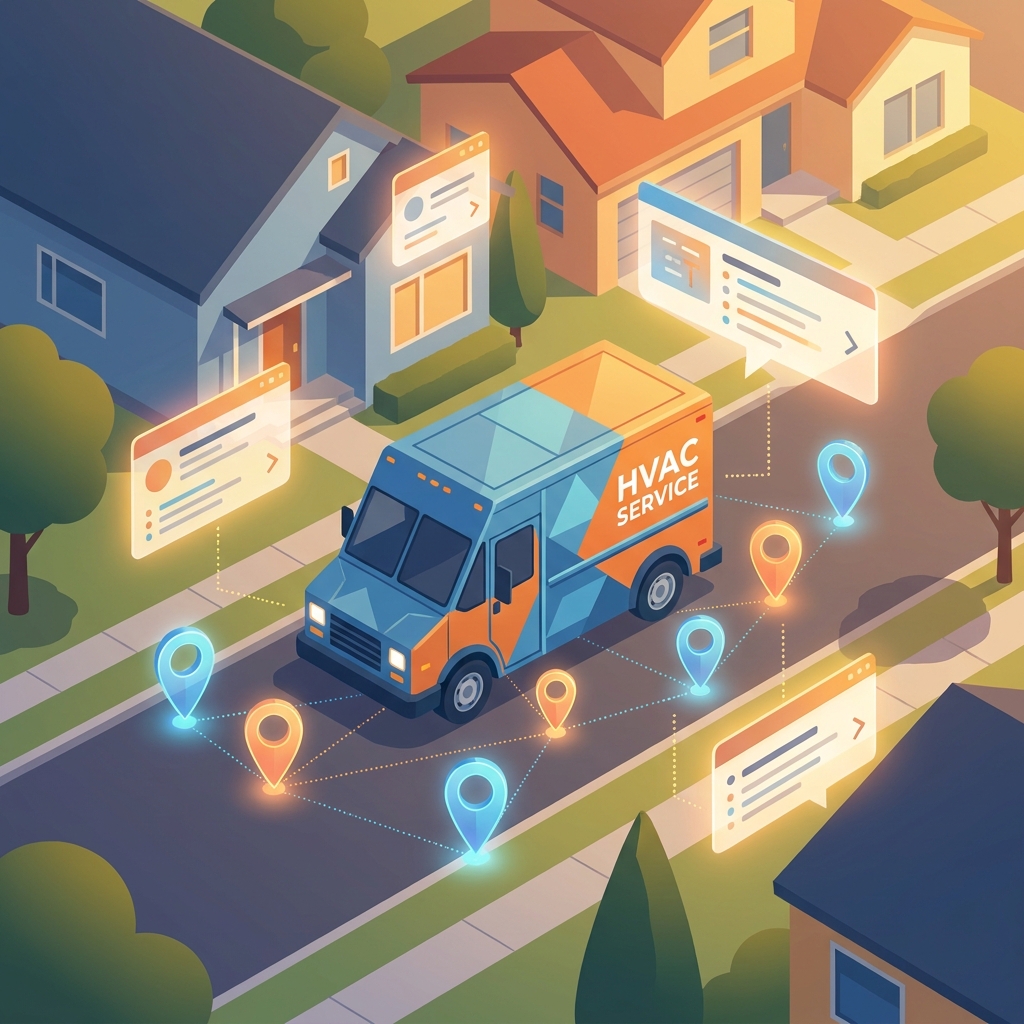
SEO Content for HVAC Contractors: The Service-Area Capture Playbook for 2026
Introduction: The Demand Is There, The Visibility Isn’t
The search demand for HVAC services is staggering. The single query “ac repair” pulls roughly 550,000 monthly searches nationally, while “HVAC near me” generates around 63,000 searches every month, a figure that has grown 120% over the last two years. This is one of the largest, highest-intent audiences in any local trade, and it is actively looking for a contractor to call right now.
Yet the businesses closest to that demand are the least equipped to capture it. About 70% of HVAC contractor firms are independents with fewer than 10 employees. These operators have the local presence customers want but almost none of the bandwidth needed to compete for search visibility. That is the core tension of HVAC marketing in 2026.
Ad-hoc blogging and one-off service pages cannot close a gap this large. When enterprise competitors publish 10 to 20 new pages every week, a contractor who publishes a dozen pieces a year simply cannot keep pace. The math does not work.
This article makes a systems-level argument: automated, interconnected SEO content, built around service-area pages, emergency-intent queries, and AI Overview citations, functions as a unified lead capture engine rather than a collection of isolated tactics. The stakes are clear. Organic search generates 42% of all HVAC lead volume at a 50% close rate, and SEO leads cost between $10 and $30 each versus $100 to $230 for non-branded Google Ads clicks. For independent operators, the cost and volume advantage of organic is decisive.
Why HVAC Search Demand Is Unlike Any Other Trade Vertical
The U.S. HVAC contractor services market is valued at roughly $152 to $159 billion in 2026, with approximately 120,000 to 125,000 contractor firms and 570,000 technicians. It is one of the largest and most fragmented trade verticals in the country. The heating and air-conditioning contractors industry alone sits at $159.4 billion as of 2026, growing steadily since 2021.
What sets HVAC apart is demand volatility. Services show a 250% to 600% variance between peak and off-peak months. AC repair search volume surges 266% in July, while furnace repair peaks 137% above baseline in January. These are predictable, recurring spikes, and they reward contractors who prepare for them.
The emergency-intent dynamic compounds this. Roughly 80% of HVAC searches happen outside normal business hours, and 60% of emergency calls originate from mobile search. When a homeowner’s AC fails during a heat wave, they are in crisis and will call the first credible result they find.
The mobile-first reality is non-negotiable. About 65% of HVAC leads come from mobile devices, and mobile “HVAC near me” searches have grown 120% in two years. Pages must be built for mobile-first indexing and fast load times, or they lose the lead before the phone rings.
Then there is the heat-wave multiplier. A single heat wave can increase AC repair searches by 400% in 24 hours. Contractors who have already published and indexed service-area content capture that surge; those who have not are invisible during the most valuable 48-hour window of the year. Finally, 34% of consumers are currently delaying HVAC services due to economic strain, a large pool of future buyers that well-positioned content can begin nurturing before competitors notice them.
The Content Gap: Why Independent HVAC Contractors Are Structurally Underrepresented in Search
The content gap is simple to state and difficult to close. HVAC search demand is enormous and growing, but the businesses best positioned to serve local customers, small independents, are the least equipped to produce content at the volume required to compete.
The publishing disparity is stark. Enterprise HVAC brands publish 10 to 20 new pages weekly. Regional players add 5 to 10 pages weekly. Local businesses are advised to target 1 to 2 pages weekly, yet most independent contractors publish fewer than 12 pieces of content per year.
Proximity alone is not enough to bridge this gap. Proximity accounts for roughly 55% of the Map Pack ranking decision, but a single Google Business Profile cannot rank across a wide metro without supporting service-area pages. The content infrastructure has to exist before proximity can be leveraged.
The competitive barriers are severe. HVAC is the most review-competitive trade in the U.S., with a median of 2,084 Google reviews required to crack the top 3 in competitive markets. Reviews take years to accumulate. Content, by contrast, is the lever an independent operator can actually control.
Most guides warn against templated city pages but never explain how to produce genuinely differentiated content at scale. That is the thin content trap, and it is precisely the gap automated SEO content solves. The bandwidth math is brutal: a single contractor or office manager cannot research, write, optimize, and publish 15 to 60 pieces of locally differentiated content per month while also running service calls, dispatching technicians, and managing customers.
The Unified Lead Capture Engine: How Automated SEO Content Works as a System
The strategic shift is to stop treating GBP optimization, service-area pages, seasonal content, and AI citation as separate tactics. Positioned correctly, they are interconnected components of a single lead capture system in which each element amplifies the others.
The architecture matters. Automated content platforms like KOZEC build topically structured, interlinked content ecosystems rather than isolated standalone pages. Internal linking signals topical authority to Google while guiding users through the conversion funnel. KOZEC’s agentic AI handles business and competitor analysis, topic discovery, content gap identification, structured content creation, page organization, internal linking, and automated publishing directly to WordPress, removing the human bottleneck at every stage.
The output advantage is significant. KOZEC’s Foundation plan delivers 15 content pieces per month, while its Scale plan delivers 60. A traditional SEO agency typically produces 8 to 12 articles per month at $8,000 to $15,000, meaning automated platforms produce five to seven times more content at roughly one-tenth the cost.
Underpinning all of this is KOZEC’s SCO (Search Compliance Optimization) framework, which focuses on Google’s recommended best practices: useful content, clear pages, smart internal links, and consistent publishing rather than algorithmic shortcuts that risk penalties. The effect compounds as well. Content published in October builds Map Pack positions that are nearly impossible to displace by the following summer. That off-season publishing window is a competitive moat most contractors leave completely unguarded.
Service-Area Pages: The Foundation of Local Search Dominance
The reason they work is intent. Some 46% of all Google searches carry local intent, and 42% of those local searches result in clicks on Map Pack listings. Service-area pages give Google the geographic signals needed to surface a contractor for searches in specific neighborhoods, cities, and suburbs.
The line between an effective page and a thin one is content differentiation. Each page must include locally specific material: neighborhood climate context, local permit requirements, and area-specific equipment considerations. A city name swapped into a template is exactly what Google’s helpful content standards penalize.
This creates a scalability problem. Manually writing unique, locally differentiated content for 20 to 50 or more cities is prohibitively time-consuming for small operators. That is precisely the problem automated content platforms solve.
The blueprint for each page is consistent: target a specific city-plus-service combination such as “AC repair in [City]” or “furnace installation in [City],” include schema markup, click-to-call CTAs, an FAQ section, and internal links to related service pages. This organic web presence amplifies GBP signals, which account for 32% of Map Pack ranking weight, and review signals, which account for another 20%, while extending geographic reach beyond the immediate proximity radius.
Building the Service-Area Page Network at Scale
For a single-location contractor serving a metro area, the architecture starts with a hub page for the primary service city, then builds spoke pages for each surrounding suburb and service-type combination.
The internal linking strategy ties it together. Hub pages link to all relevant spoke pages; spoke pages link back to the hub and to related service pages. This structure signals topical authority and distributes page authority across the entire network.
Content differentiation remains the rule. Each page must include at least one locally specific element: a reference to local weather patterns, area-specific equipment considerations, neighborhood service history, or local permit and code information.
Volume targets are eye-opening. A contractor serving a mid-size metro with 15 to 20 surrounding communities and offering 5 to 6 core services needs 75 to 120 unique service-area pages for comprehensive coverage. That is impossible to produce manually but entirely achievable with a platform publishing 15 to 60 pieces per month.
Two technical points reinforce the network. Switching a GBP primary category from generic “Contractor” to “HVAC contractor” lifts Map Pack visibility by an average of 31%, and service-area pages echo that category signal across the organic web. Speed is also a lead multiplier: improving page load time from 4.2 seconds to 1.4 seconds increased phone leads by 45% for one heating company. Pages must be technically optimized, not just content-rich.
Emergency-Intent Queries: Capturing the Highest-Value HVAC Searches
Emergency-intent queries, including “AC not working,” “furnace stopped working,” “no heat emergency,” and “HVAC repair near me open now,” represent the highest-conversion, highest-ticket search intent in the vertical.
The mobile-emergency connection defines how these pages must be built. With 60% of emergency calls originating from mobile search and 80% of HVAC searches happening outside business hours, emergency pages must be mobile-optimized, load instantly, and feature prominent click-to-call functionality above the fold.
The content structure should lead with the solution and the phone number, follow with a brief diagnostic checklist to build trust and reduce bounce, include FAQ schema for common emergency symptoms, and close with a clear service-area confirmation.
A wide-open after-hours opportunity exists here. Most contractors do not have dedicated after-hours emergency pages. A page targeting “[City] emergency AC repair 24/7” or “[City] no heat emergency” captures searchers at the exact moment of maximum urgency and minimum competition.
Emergency content also feeds AI Overviews, which increasingly answer these queries directly. Content that answers “what to do when your AC stops working” or “how to tell if your furnace needs emergency repair” is prime citation material. The ticket value justifies the effort: HVAC customer lifetime value averages $15,340 against an acquisition cost of $296 to $350. A single emergency call captured organically can initiate a relationship worth tens of thousands of dollars in recurring maintenance, replacement, and referral revenue.
Seasonal Content Strategy: Publishing Before Demand Spikes
Google indexes and ranks content over weeks, not hours. Contractors who publish pre-season content in March and April capture the June through August AC repair surge. Those who publish in June are already invisible during the peak.
The variance is predictable and worth planning around. AC repair search volume surges 266% in July; furnace repair peaks 137% above baseline in January. These recurring spikes can be pre-positioned for every year.
This is where the off-season moat lives. Most contractors go quiet on content from October through January, exactly when they could be building the Map Pack positions that will dominate the following summer.
A practical seasonal calendar looks like this:
- Pre-summer (March to May): AC tune-up, AC replacement, and cooling efficiency queries.
- Pre-winter (September to November): Furnace tune-up, heat pump installation, and heating efficiency queries.
- Off-season (December to February): Deferred-demand queries, financing options, and “repair vs. replace” decision content.
There is also a fresh content opportunity in refrigerant regulation. The AIM Act R-410A phase-out and A2L refrigerant transition, with federal rules now prohibiting new R-410A system installations as of January 1, 2026, creates enormous informational demand. Queries like “what the refrigerant change means for your AC system” and “will my old AC still be serviced?” are being searched, and almost no contractor is answering them. A platform publishing 15 to 60 pieces per month can execute this entire calendar, pre-season through off-season, without the contractor managing an editorial calendar by hand.
AI Overview Citations: The New Layer of HVAC Search Visibility
The search landscape has shifted fast. A 2026 BrightLocal survey found 45% of consumers now use AI tools like ChatGPT, Perplexity, and Google AI Mode to find local services, up from just 6% a year earlier. AI citation optimization is no longer optional.
The citation gap surprises many contractors. Only about 38% of AI Overview citations come from pages ranking in the top-10 organic results, meaning strong traditional rankings alone do not guarantee AI visibility. AI citation must be treated as a distinct objective.
Earning citations requires content that directly answers specific homeowner questions in clear, structured language; pages with proper schema markup; entities (business name, address, phone, service area) consistent across all web properties; and demonstrated expertise, authoritativeness, and trustworthiness.
Certain formats are especially citable: FAQ sections with schema, step-by-step diagnostic guides, cost comparison tables, and “how to choose an HVAC contractor” content. This is where KOZEC’s GEO (Generative Engine Optimization) capability comes in, structuring content specifically for visibility in AI-generated results. With AI Overviews now appearing on roughly 30% of informational queries in the U.S., HVAC blog content must do double duty: rank for the query and qualify for AI citation, which demands a higher standard of structure and depth than traditional SEO alone.
Structuring HVAC Content for AI Recommendation Engines
AI systems recommend contractors based on entity consistency. The business name, address, phone number, service area, and category must be identical across the GBP, website, citations, and all structured data.
FAQ schema is essential. FAQ pages convert 20% more visitors and provide the structured question-and-answer format AI systems prefer for citation. Every service page and service-area page should include a locally relevant FAQ section with schema markup.
The direct-answer format matters as well. AI Overviews favor content that answers a specific question in the first one or two sentences, then provides supporting detail. HVAC content should lead with the answer, not bury it after paragraphs of background.
Structured data is a visibility multiplier, increasing local search visibility by 43%. Relevant schema types include LocalBusiness, Service, FAQPage, HowTo, and Review. KOZEC’s GEO feature builds this into the automated workflow rather than treating it as a separate manual step. The payoff is quality, not just quantity: AI-sourced traffic converts at four to five times the rate of traditional organic traffic, making AI citation a measurable lead-quality improvement.
The ROI Case: Why Automated SEO Content Outperforms Every Alternative
The cost comparison is the starting point. SEO leads cost HVAC companies $10 to $30 each, compared to $100 to $230 for non-branded Google Ads clicks, a 5x to 10x advantage that compounds as rankings build.
The ROI benchmarks are compelling. HVAC contractors see a median 27.46x SEO ROI, with top performers exceeding 60x, versus paid search at 4.4x ROAS after month six. One documented case study shows a contractor growing from $500K to $4.3M in trackable revenue over three years with a 13.8x marketing ROI built on local SEO dominance.
Against traditional agencies, automated platforms win decisively. Agencies charge $8,000 to $15,000 per month for 8 to 12 articles; KOZEC delivers 15 to 60 or more articles per month at $600 to $1,500, a five-to-seven-times content advantage at roughly one-tenth the cost.
The lifetime value math seals the case. With an average customer lifetime value of $15,340 and an acquisition cost of $296 to $350, a single organic lead that becomes a long-term customer returns 44x or more on acquisition spend. Even modest organic traffic improvements become highly valuable at that ratio.
On timing: early users of automated content platforms report measurable organic traffic growth within 60 to 90 days, with the full compounding effect of a service-area network materializing over 6 to 12 months and the 40% to 60% local traffic benchmark achievable within six. Speed to launch also matters. KOZEC deploys in days, not the 4 to 8 weeks typical of agency onboarding, a critical edge for contractors facing an imminent seasonal spike.
Conversion Rate Optimization Layered onto SEO Content
Most guides treat SEO and CRO as separate disciplines, but traffic that does not convert is wasted. Conversion elements built into content architecture improve both lead volume and lead quality.
Pricing transparency is a major lever. Roughly 47% of HVAC website visitors leave if no pricing information is visible, so service pages and service-area pages should include at minimum a cost range or “starting at” price point to reduce bounce and build trust.
FAQ sections should be standard on every page, given the 20% conversion lift they provide, addressing common objections at the point of decision. Because 65% of HVAC leads come from mobile, every page needs a prominent, above-the-fold click-to-call button. That is a content architecture decision, not just a design one.
The deferred-demand angle deserves attention as well. With 34% of consumers delaying service, content targeting “HVAC financing options,” “repair vs. replace calculator,” and “how long does an HVAC system last” captures buyers earlier in the decision cycle. HVAC companies with blogs generate 67% more monthly leads; informational content builds trust, captures early-funnel searchers, and creates the internal linking opportunities that strengthen the entire ecosystem.
Choosing the Right Automated Content Plan for Your HVAC Business
The right content volume depends on market competitiveness, service-area size, current visibility, and the gap between current output and what competitors publish.
- Foundation ($600/month, 15 pieces): Best for single-location contractors in smaller markets or those just beginning their service-area network. Sufficient volume to establish a foundation and begin capturing traffic within 60 to 90 days.
- Momentum ($1,000/month, 30 pieces): Best for contractors serving mid-size metros with multiple surrounding communities. Sufficient volume to build a comprehensive network across 10 to 15 cities while maintaining ongoing blog content.
- Scale (from $1,500/month, 60 pieces): Best for multi-location companies, regional operators, or contractors in highly competitive markets. Delivers the velocity to match enterprise output, with competitive analysis and structured data optimization included.
The architecture distinction matters when scaling. Single-location operators need a hub-and-spoke structure; multi-location companies need separate content ecosystems for each location with cross-location internal linking, which the Scale tier’s multi-location support handles automatically. KOZEC’s cancel-anytime model also lets contractors scale up before peak season and adjust as needed, eliminating the long-term commitment risk that makes agency relationships difficult for small operators.
Conclusion: Closing the Visibility Gap Before Competitors Do
The HVAC contractors who dominate local search in 2026 are not those who optimize one GBP or publish one seasonal blog post. They are the ones who have built an interconnected ecosystem of service-area pages, emergency-intent content, seasonal articles, and AI-citation-ready FAQ content that functions as a unified lead capture engine.
Automated SEO content is not a nice-to-have. It is the structural answer to the gap between massive search demand and the bandwidth limits of small operators. Every service-area page published today is a permanent asset that captures leads next summer, the summer after, and every season that follows. The ROI compounds in a way paid ads never can.
The off-season publishing window is open right now. Contractors who build their service-area networks before the next spike will own Map Pack positions that are nearly impossible to displace. Those who wait will spend next summer paying $100 to $230 per click for leads their organic content could have captured for $10 to $30. As AI search reshapes how homeowners find contractors, with 45% already using AI tools, the content infrastructure built today will determine AI recommendation visibility tomorrow.
Ready to Close the Content Gap? See How KOZEC Builds Your HVAC Lead Capture Engine
The gap between HVAC search demand and independent contractor visibility is a structural problem. KOZEC is the structural solution.
For HVAC contractors specifically, KOZEC delivers 15 to 60 interlinked, service-area-targeted pieces per month, published automatically to WordPress and built around the emergency-intent queries and local search signals that drive real leads. Setup takes days, not months, with measurable organic traffic growth typically visible within 60 to 90 days and a full service-area network delivering results within six.
Next steps: Book a demo at kozec.ai/schedule-a-demo/ or call (888) 545-7090 to discuss which plan fits your market size, service area, and competitive landscape.
Not ready to commit? Start with the Foundation plan at $600/month with no long-term contract, a low-risk way to begin building your content infrastructure before the next peak season arrives.
Stay In The Loop
Subscribe to our free newsletter.
Stop Managing SEO - Start Scaling It
Let KOZEC handle strategy, content, and execution - so you can focus on growth.
Automated SEO content for growing agencies.
KOZEC helps agencies, consultants, and growing brands publish high-quality SEO content on autopilot — so your site ranks higher and converts more visitors.
Managing SEO content for many client websites doesn’t scale with traditional methods. Writers are expensive and inconsistent, keyword research is time-consuming, and publishing requires multiple manual steps. As agencies grow, maintaining both quality and consistency becomes increasingly difficult. KOZEC (Keyword Optimized Zero Effort Content) solves this by automating analysis, keyword discovery, content creation, and publishing—so your clients get reliable SEO content while your team focuses on growth.
Increase organic traffic without manual content creation
Publish keyword-optimized posts automatically to WordPress
Turn SEO into a predictable, scalable growth channel