SEO Content Results Timeline: What to Expect at 60, 90, and 365 Days in 2026
SEO Content Results Timeline: What to Expect at 60, 90, and 365 Days in 2026
August 21, 2026
SEO Content Results Timeline: What to Expect at 60, 90, and 365 Days in 2026
Introduction: The SEO Timeline Conversation Nobody Is Having Correctly
Here is the uncomfortable truth at the center of nearly every content marketing engagement: 68.8% of SMB owners expect SEO results in under three months, according to research from HigherVisibility, while most agency content opens with a “4 to 12 months” disclaimer that lands like a polite brush-off. The result is a chronic mismatch of expectations, one that erodes trust before a single article gets published.
That framing is broken. The 60 to 90 day window is not a waiting period to be endured. It is a measurable proof point, packed with specific, observable signals that confirm whether a well-structured campaign is actually working. The problem is not that early results do not exist. The problem is that most people are measuring the wrong things.
This article draws a hard line that will run through every section: what a business will see at each milestone versus what it will not see yet, and why that distinction is the single most important input for smart decision-making. Google’s own canonical benchmark, delivered by former Developer Programs Tech Lead Maile Ohye, still holds: “In most cases, SEOs need four months to a year to help your business first implement improvements and then see potential benefit.” True, but incomplete. That guidance treats every domain, keyword strategy, and methodology as identical. They are not.
What follows is a concrete milestone framework for 60 days, 90 days, and 365 days, grounded in 2026 data, that gives businesses a credible, methodology-backed way to evaluate progress. Throughout, the strategic lens is KOZEC’s SCO (Search Compliance Optimization) framework: following Google’s recommended best practices rather than chasing algorithmic shortcuts. Not as a pitch, but as the mechanism that determines whether those early proof points appear on schedule.
Why SEO Timelines Vary: The Variables That Control Your Speed
“How long does SEO take?” is the wrong question. The right one is: “What conditions determine how fast the signals appear?” Five variables control the answer.
Variable 1: Domain age and authority. Established domains with good technical health can see measurable movement within 60 to 90 days after on-page optimization. New domains, lacking trust signals and backlink history, should plan for a 12-month foundation phase before meaningful first-page positions materialize.
Variable 2: Keyword competition level. Low-competition, long-tail keywords can rank in as little as 1 to 3 months. Short, highly competitive head terms can take 7 to 18 months or longer.
Variable 3: Content strategy type. Topical authority methodology (building 25 to 30 interlinked cluster articles) produces ranking gains up to 3x faster than isolated, one-off page creation, per analysis of more than 400 campaigns.
Variable 4: Technical health baseline. Google’s John Mueller has noted that simple on-page changes, such as title tags, can be re-crawled and reprocessed quickly, while larger structural issues require far more evaluation time.
Variable 5: Publishing consistency and volume. Companies maintaining consistent blogging schedules report 13x more positive ROI than irregular publishers. Volume compounds velocity.
Then there is the data point everyone cites to discourage: a 2025 Ahrefs study of one million URLs found only 1.74% of newly published pages reached the top 10 within a year, down from 5.7% in 2017. But consider the inverse. Of the pages that do rank within a year, the majority achieve it in roughly 61 to 182 days. That directly validates the 60 to 90 day early-signals window for strategically targeted campaigns.
This article focuses on one specific scenario: an established domain running a systematic topical authority methodology. That is precisely where 60 to 90 day proof points are achievable.
What “Results” Actually Means in 2026
Measuring SEO success exclusively by traffic clicks in 2026 misses most of the picture. Nearly 60% of Google searches now end without a click. Impressions, brand visibility, and AI Overview citations are no longer consolation prizes. They are legitimate, valuable results.
The 2026 results spectrum runs as follows: traditional rankings, featured snippets, People Also Ask appearances, AI Overview citations, traffic, leads, and finally revenue. Success accumulates across that entire chain, not just at the traffic node.
This is where AEO (Answer Engine Optimization) and GEO (Generative Engine Optimization) enter as early-result categories. Brand appearances inside AI-generated answers can precede traditional rank-1 positions, and the opportunity is expanding fast. AI Overviews now appear on 48% of Google queries as of April 2026, up from 31% in February 2025. Citation visibility is a measurable, meaningful early win that most competitors never think to track.
Every milestone below is evaluated across multiple result types, not traffic alone.
The 60-Day Milestone: Your Campaign’s First Report Card
Sixty days is the technical foundation and crawl activity phase. This is when the infrastructure for future results gets built and verified. Treat it as a diagnostic checkpoint, not a disappointment. What appears at 60 days reveals whether the campaign is structurally sound.
What You Will See at 60 Days
- Improved crawl activity. Google Search Console shows increased crawl frequency as new and optimized pages get discovered and indexed.
- Rising page index count. New content appears in the GSC Coverage report, a direct signal that Google is processing the content ecosystem.
- Non-branded impression growth. Early impressions for target keywords surface in the Performance report, even at low positions (the 15 to 40 range). This is the first measurable organic signal.
- Technical health improvement. If a technical audit anchored the initial phase, Core Web Vitals, crawl error reduction, and structured data validation should all show measurable gains.
- Visible internal linking structure. The interconnected content ecosystem, a hallmark of topical authority methodology, is verifiable through any site crawl.
- Early long-tail appearances. Low-competition target keywords begin surfacing in impressions data, often at positions 20 to 50, confirming Google has associated the content with those queries.
- Baseline data established. The 60-day mark delivers the first meaningful before-and-after comparison for impressions, indexed pages, and crawl activity.
What You Will Not See Yet at 60 Days (And Why That Is Normal)
- Significant organic traffic. Traffic requires rankings, and rankings are still forming. Expect impressions without substantial clicks.
- First-page rankings for primary terms. Competitive keywords need more time for Google to evaluate topical authority and trust.
- Lead or revenue attribution. The conversion funnel needs traffic volume that has not yet materialized.
- Stable rankings. Early positions fluctuate as Google tests content in different slots. This is expected, not alarming.
The reason is mechanical. Google’s evaluation of new content involves multiple crawl cycles, quality assessments, and comparative ranking tests. Sixty days is often only two or three full evaluation cycles for a new content cluster. The absence of traffic at this stage does not indicate failure. It indicates the foundation phase is proceeding correctly, and the signals that are present serve as the right leading indicators.
The 90-Day Milestone: Early Proof Points Emerge
Ninety days is the first genuine proof-of-concept window. On an established domain, a well-structured campaign should now produce observable, shareable results. Research from MH Tech Solutions confirms most businesses see their first meaningful SEO signals within 60 to 90 days, and of pages that reach the top 10 within a year, most do so in 61 to 182 days. This is the moment to present progress to stakeholders.
What You Will See at 90 Days
- 20%+ non-branded impression growth versus the pre-campaign baseline in GSC. A concrete, observable benchmark.
- Long-tail rankings in positions 5 to 20. Targeted low-competition terms enter the top 20, with some cracking the top 10.
- First organic traffic from long-tail terms. Not yet substantial, but the first non-branded sessions appear. This is a qualitative milestone as much as a quantitative one.
- Featured snippet and People Also Ask appearances. Well-structured content answering specific questions can earn SERP features before achieving rank-1.
- AI Overview citation appearances. GEO and AEO-structured content may begin surfacing in AI Overview citations, a 2026-specific win competitors rarely mention.
- Content cluster cohesion. Multiple pages within the same topical cluster show impression growth together, confirming Google recognizes the topical authority signal.
- Topical authority trajectory. As the campaign approaches the 25 to 30 article threshold, the compounding effect becomes visible in the rate of impression growth. Sites reaching that threshold see 40 to 70% keyword ranking increases within 3 to 6 months. The 90-day mark is when that trajectory becomes readable.
What You Will Not See Yet at 90 Days (And the Right Way to Frame It)
- Consistent first-page rankings for competitive keywords. These require sustained authority signals that typically need 6 to 12 months.
- Significant lead or revenue attribution. Traffic volume is usually insufficient for consistent lead flow, though early conversions may appear.
- Full ROI. The 6 to 14 month break-even timeline means 90 days remains firmly in the investment phase.
- Stable, predictable traffic. Rankings still fluctuate. Consistency arrives in months 4 through 6.
The 90-day milestone is not about traffic volume. It is about trajectory confirmation. The signals present at this stage (impression growth rate, long-tail appearances, crawl health) are predictive of the 6-month and 12-month outcomes. The work done in months 1 through 3 does not produce linear results. It builds the foundation for exponential gains later.
Why Established Domains Hit Early Signals Faster: The Domain Authority Advantage
Established domains carry pre-existing crawl budgets, trust signals, and backlink profiles that Google uses to evaluate new content faster. New domains lack all of that and must build it from scratch, which is exactly why the 12-month planning horizon is appropriate for them.
The advantage is conditional, however. An established domain with poor technical health (crawl errors, slow Core Web Vitals, thin content) forfeits its edge. A technical audit in month one is not optional. It is the prerequisite for 60 to 90 day early signals.
The accelerant is topical authority. Established domains that add a systematic cluster of 25 to 30 interlinked articles can leverage existing authority to rank new cluster content faster than their raw domain metrics would suggest. This is why one-off content fails to keep pace: a single optimized page ranks slower than a coordinated cluster because Google evaluates topical depth, not just individual page quality.
KOZEC’s SCO methodology is built on exactly this principle. By constructing interconnected content ecosystems rather than isolated pages, the framework is engineered to trigger the topical authority signal that accelerates Google’s trust evaluation on established domains.
The 365-Day Milestone: Where SEO Becomes a Compounding Asset
Twelve months marks the transition from investment phase to compounding-returns phase, where the ROI arc inflects upward. The data justifies the patience: SEO ROI averages 748% over three years, per Web Tonic, with most campaigns breaking even between months 6 and 14. A Semrush study reported by Search Engine Land found 41% of domains reach the top 10 within six months, but only 27% remain there, which underscores that sustaining rankings demands the ongoing authority-building a systematic methodology provides.
What You Will See at 365 Days
- Multiple first-page rankings for primary target keywords.
- Consistent, growing organic traffic. The trickle from month 3 becomes a reliable channel contributing meaningfully to total site traffic.
- Lead generation and revenue attribution. Organic traffic at this volume and quality produces trackable leads and, for most models, attributable revenue.
- Content compounding effect. Sites sustaining cluster publishing for 12 or more months see 40% higher organic traffic than single-page strategies.
- A SERP feature portfolio. A mature cluster earns multiple AI Overview citations and featured snippets.
- Evergreen value. Posts published in months 1 through 3 keep working. A blog post published today generates organic traffic for an average of 3.5 years with no additional spend.
- Scale advantage. Per Digital Applied, organizations with 400 or more indexed blog posts generate 4.2x more leads than those with fewer than 100. Consistent publishing pushes many businesses toward that threshold by month 12.
- Competitive displacement. Content accumulating engagement signals for 6 to 12 months begins displacing weaker established competitor pages, even though the average number-one page is now roughly five years old.
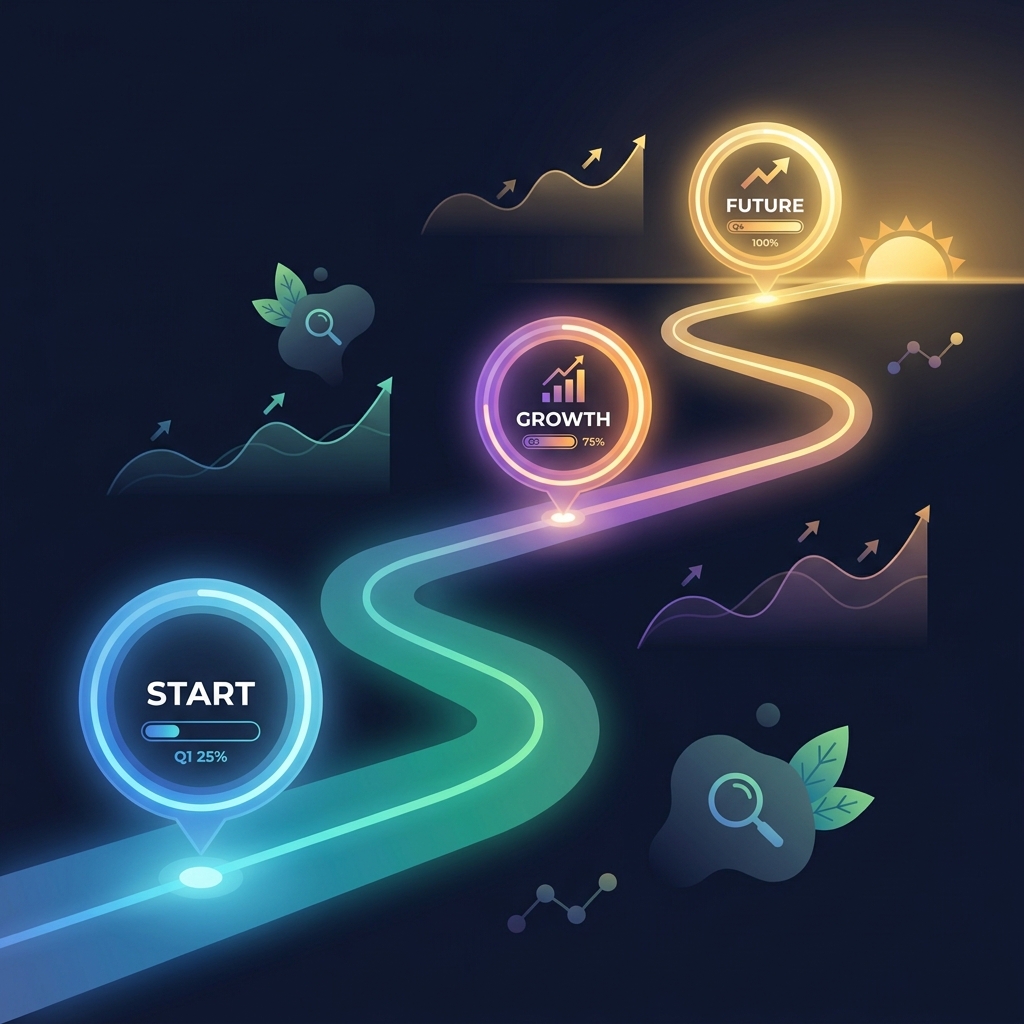
The 12-Month ROI Arc: Visualizing the Compounding Curve
- Months 1 to 3 (Foundation): Costs exceed returns. Signals are leading indicators.
- Months 3 to 6 (Early Returns): First traffic, first leads, first conversions.
- Months 6 to 12 (Break-Even and Growth): ROI turns positive. Traffic compounds.
- Months 12+ (Compounding): Returns accelerate while marginal costs decline.
The 6 to 14 month break-even is not a weakness. It is the mechanism that creates the 748% three-year ROI that paid channels cannot replicate. Paid traffic stops the moment spend stops. Organic content published today keeps generating traffic for 3.5 years. Add the quality gap (SEO leads close at 14.6% versus 1.7% for outbound), and the case compounds beyond raw volume. Content marketing generates 3x more leads than outbound at 62% lower cost. That is the destination the 60 and 90 day milestones are building toward.
The Topical Authority Methodology: Why KOZEC’s SCO Framework Compresses the Timeline
The difference between a 60 to 90 day proof point and a six-month wait is not luck or domain age alone. It is methodology.
SCO (Search Compliance Optimization) in plain terms means following Google’s recommended best practices (useful content, clear page structure, smart internal links, consistent publishing) instead of chasing shortcuts. Topical clusters accelerate timelines because Google evaluates topical depth across a site. A coordinated cluster of 25 to 30 interlinked articles signals expertise faster than scattered pages, which is why topical-authority-first sites see ranking gains up to 3x faster.
KOZEC’s approach builds content that links to and reinforces related content on the same site, creating the internal authority signals that speed Google’s trust evaluation. The platform produces 15 to 60 or more articles per month, the volume required to hit cluster thresholds quickly, while maintaining SCO compliance standards. Content structured for AI Overview citations and featured snippets can deliver brand visibility wins in the 60 to 90 day window before traditional rankings mature.
The contrast is stark. A business publishing one or two articles per month without a cluster strategy will not see 60 to 90 day proof points. The methodology is the differentiator, not the activity.
Setting Realistic Expectations: A Milestone Checklist for Each Phase
60-Day Checklist:
- Technical health score improvement visible
- Crawl activity increase in GSC
- Indexed page count growing
- Non-branded impressions appearing
- Early long-tail appearances in positions 20 to 50
- Internal linking structure verified
90-Day Checklist:
- 20%+ non-branded impression growth vs. baseline
- Long-tail rankings in positions 5 to 20
- First organic traffic from non-branded queries
- Featured snippet or PAA appearances
- AI Overview citation appearances (GEO-structured content)
- Topical cluster cohesion across multiple pages in GSC
365-Day Checklist:
- Multiple primary keywords on page 1
- Consistent, growing organic traffic channel
- Lead generation and revenue attribution from organic
- Content compounding effect visible in analytics
- AI Overview and SERP feature portfolio
- Evergreen content from months 1 to 3 still generating traffic
Red flags to watch: Zero impression growth at 60 days may indicate indexation issues. Zero long-tail appearances at 90 days may point to keyword targeting problems. These milestones assume an established domain, good technical health, a systematic topical authority methodology, and consistent publishing volume. They do not apply to new domains or one-off content approaches.
Addressing the SMB Expectation Gap Directly
Returning to that 68.8% of SMB owners expecting results in under three months: that expectation is not unreasonable. It is simply measuring the wrong things. SMBs are right to want early evidence their investment is working. The failure belongs to agencies that define “results” too narrowly and miss the signals actually present at 60 to 90 days.
The reframe is straightforward. If “results” includes impression growth, crawl activity, indexation, long-tail appearances, and AI Overview citations, then results at 60 to 90 days are not only possible; they are expected from a well-run campaign. What SMBs legitimately cannot expect in under three months is consistent first-page rankings for competitive terms, significant lead volume, or positive ROI. Those live on the 6 to 14 month arc.
The honest bridge is this: the 60 to 90 day proof points are not the destination. They are evidence the campaign is on the right trajectory toward outcomes that deliver business impact. Providers offering specific, measurable milestones at each phase, rather than vague “be patient” messaging, are demonstrating methodological confidence. With 61% of marketers increasing SEO spend in 2026 and AI tools compressing content production, the landscape rewards businesses that start systematic programs now rather than waiting for certainty.
Conclusion: The Timeline Is Not the Variable. The Methodology Is.
The SEO timeline question was never “how long does it take?” It is “what methodology is being used, and what domain conditions are the starting point?”
The framework is straightforward: 60 days delivers technical proof points, 90 days delivers early ranking and visibility signals, and 365 days delivers a compounding organic asset with measurable ROI. The 2026 context expands the opportunity further. With AI Overviews on 48% of queries, zero-click searches at nearly 60%, and organic search still driving 47 to 53% of all web traffic, the definition of success has broadened, and so has the room for early wins.
Businesses that understand what to measure at each phase, and use a methodology built to produce those signals, can validate their investment at 60 to 90 days while building toward the returns that arrive at 12 months and beyond. The difference between waiting for results and seeing proof points on schedule is not patience. It is the systematic, compliance-first approach that builds topical authority faster than tactical alternatives.
Ready to See Your First 60-Day Proof Points? Here Is How to Start
If the milestone framework above resonates, the natural next step is applying it to a real business. Find out what a 60-day GSC report should actually look like: schedule a demo at kozec.ai/schedule-a-demo/ to see how KOZEC’s SCO framework maps directly to the 60, 90, and 365-day milestones described in this article.
For businesses ready to match publishing volume to their topical authority timeline, KOZEC’s pricing tiers run from Foundation at $600/month (15 content pieces monthly) through Scale starting at $1,500/month (60 pieces monthly). No long-term contracts. Setup in days, not months. The systematic topical authority methodology produces the early signals outlined here.
Prefer to talk it through first? Call (888) 545-7090 or visit kozec.ai to start building the content ecosystem that turns 60-day proof points into a 12-month compounding asset.
Stay In The Loop
Subscribe to our free newsletter.
Stop Managing SEO - Start Scaling It
Let KOZEC handle strategy, content, and execution - so you can focus on growth.
Automated SEO content for growing agencies.
KOZEC helps agencies, consultants, and growing brands publish high-quality SEO content on autopilot — so your site ranks higher and converts more visitors.
Managing SEO content for many client websites doesn’t scale with traditional methods. Writers are expensive and inconsistent, keyword research is time-consuming, and publishing requires multiple manual steps. As agencies grow, maintaining both quality and consistency becomes increasingly difficult. KOZEC (Keyword Optimized Zero Effort Content) solves this by automating analysis, keyword discovery, content creation, and publishing—so your clients get reliable SEO content while your team focuses on growth.
Increase organic traffic without manual content creation
Publish keyword-optimized posts automatically to WordPress
Turn SEO into a predictable, scalable growth channel