
AI Content Platform With CMS Integration: The Zero-Upload Publishing Benchmark for 2026
AI Content Platform With CMS Integration: The Zero-Upload Publishing Benchmark for 2026
August 11, 2026
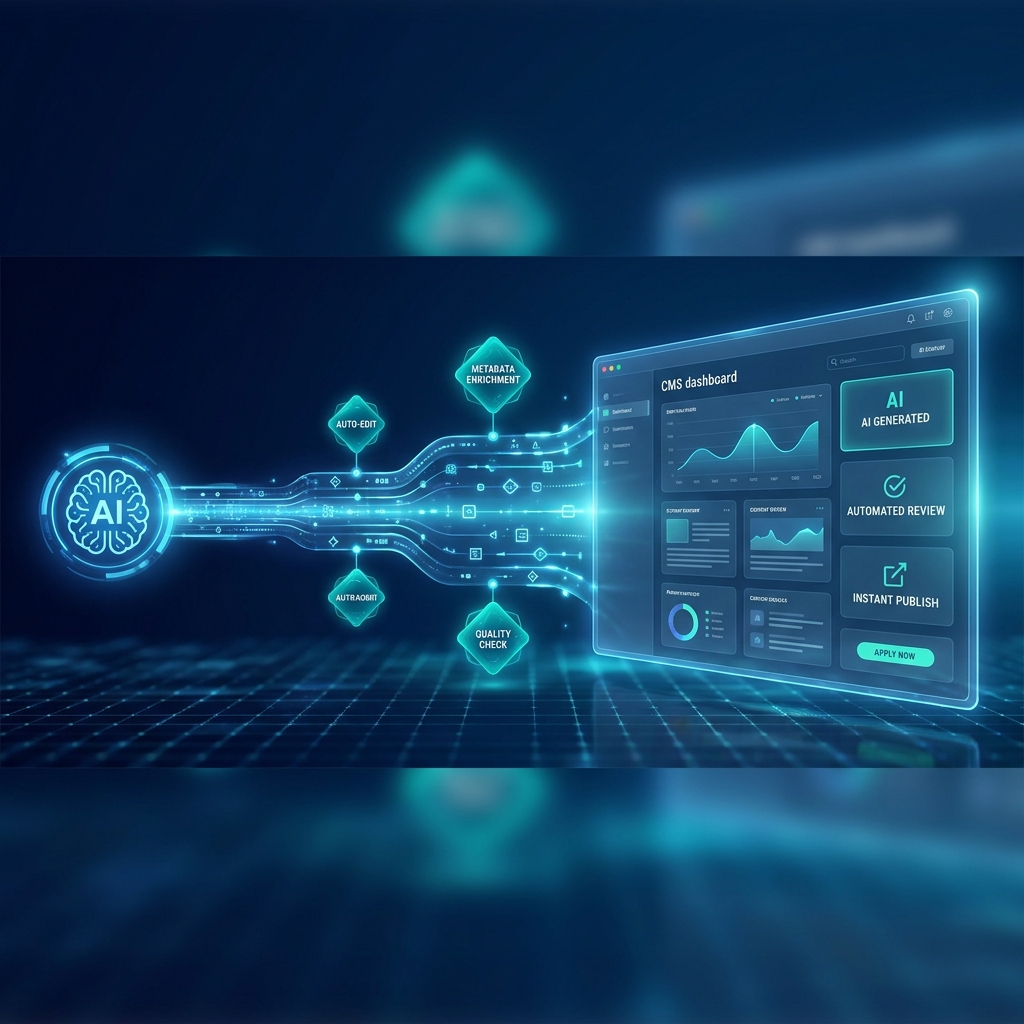
AI Content Platform With CMS Integration: The Zero-Upload Publishing Benchmark for 2026
Introduction: The Hidden Tax on Every AI-Generated Article
In 2026, the numbers tell a clear story. Roughly 85% of marketers now use AI for content creation, up from 61% in 2023. Yet 60% of content teams still cite manual distribution across channels as their single biggest operational bottleneck. The creation problem is solved. The publishing problem is not.
AI writing tools have commoditized content generation. Anyone with a subscription can produce a polished draft in minutes. But the workflow gap between “content ready” and “content live” is where time, money, and competitive advantage quietly bleed away. That gap has a name it does not deserve: integration. For most platforms, integration is more aspiration than reality.
Consider the arithmetic. Manually publishing just five articles per week at 20 minutes each burns nearly seven hours of effort every month. That figure assumes everything goes smoothly. It does not account for formatting errors, stripped metadata, broken internal links, or the missed indexing windows that let competitors get cited first in AI-generated answers. Multiply that across a real content calendar and the hidden tax on every AI-generated article becomes an operational liability.
This article introduces the Zero-Upload Publishing Score: a five-dimension benchmark for evaluating whether an AI content platform with CMS integration delivers genuine end-to-end publishing autonomy or merely integration-adjacent convenience. Most platforms score partially. As the analysis will show, KOZEC is positioned as the rare solution that scores across all five dimensions without requiring technical setup or manual intervention.
Why CMS Integration Is the 2026 Benchmark, Not a Bonus Feature
The AI-powered content creation market is valued at $4.26 billion in 2026 and growing at roughly a 21.5% CAGR, according to industry analyst estimates from Research and Markets. The category is maturing fast. Buyers have stopped asking “does it write?” and started asking “does it publish?”
That shift has a name in the industry: the Agentic CMS. The defining trend of 2026 is the move from AI as a drafting assistant to autonomous AI agents that read, write, and publish content independently inside CMS workflows. The appetite is enormous. Industry reports point to a 1,445% surge in multi-agent system inquiries between 2024 and 2025, reflecting how quickly enterprises are reorganizing around orchestrated AI publishing pipelines.
Yet the tooling has not caught up. Only 26% of B2B marketers say their organization has the proper tools to manage content across teams. The majority remain stuck in manual, disconnected workflows, stitching outputs together by hand.
The maturity landscape breaks into three tiers:
- Level 1 (roughly 50% of teams): Ad hoc AI usage with no CMS integration at all.
- Level 2 (roughly 30% of teams): Multiple disconnected tools with a human serving as the integration layer.
- Level 3 (a minority): Purpose-built AI content engines with native CMS publishing.
The business case for reaching Level 3 is measurable. Teams using AI for content management report 45% more efficient workflows and a 70% average increase in ROI, with 79% seeing improved content quality. Meanwhile, agency content workflows without CMS integration average two to four weeks from brief to published piece. Integrated platforms compress that same journey into hours.
The question then becomes concrete: what does “real” CMS integration actually look like? The Zero-Upload Publishing Score answers it.
Introducing the Zero-Upload Publishing Score: Five Dimensions of True Integration
The Zero-Upload Publishing Score is a workflow completeness benchmark. It is not a feature checklist. It is an operational standard that measures whether a platform eliminates every manual touchpoint between content creation and live publication.
Five dimensions matter because most platforms satisfy one or two and then market themselves as “integrated.” The score exposes the gap between partial integration and true publishing autonomy. The five dimensions are:
- Native Connector Depth
- Formatting Fidelity
- Metadata Passthrough
- Post-Publish Indexing Notification
- Autopilot Scheduling
Each dimension is evaluated on a pass, partial, or fail basis. A platform must earn a full pass on all five to legitimately claim Zero-Upload Publishing autonomy. This framework applies to any AI content platform with CMS integration, making it a practical internal decision tool for buyers building a business case.
Dimension 1: Native Connector Depth
Native connector depth is the difference between a platform that publishes directly via authenticated API to a CMS and one that leans on browser extensions, copy-paste workflows, or third-party middleware such as Zapier or Make.
Why it matters: browser extensions break on CMS updates, middleware adds latency and new failure points, and plugin dependencies create version conflicts. None of these qualify as native.
The competitor context is instructive. Jasper’s WordPress integration operates via a browser extension on standard plans, functional but fragile. Writesonic relies on a WordPress plugin that requires manual installation and ongoing maintenance. At the enterprise end, platforms like Contentful and Sanity offer API-first architectures that are technically deep but demand engineering resources to configure, placing them out of reach for lean marketing teams.
KOZEC publishes directly and authenticated to WordPress and major CMS platforms with no browser extension, no plugin to install, and no middleware dependency. That is native connector depth at the marketing-team level. For teams looking to understand how to automate WordPress blog publishing, the distinction between native and middleware-dependent integration is the critical starting point.
Buyer’s question: “Does the platform publish to my CMS without me installing anything, configuring a plugin, or maintaining a browser extension?”
Dimension 2: Formatting Fidelity
Formatting fidelity is the ability to transfer content from the AI platform to the CMS with every structural element intact: headings (H1 through H6), bullet and numbered lists, bold and italic emphasis, internal links, image placements, and table structures.
The hidden cost is real. Fixing formatting errors after a CMS transfer can take 15 to 45 minutes per article depending on complexity. Across a full content calendar, that is a significant recurring labor cost. Common failure modes include markdown-to-HTML conversion errors, heading hierarchy collapse, image alt text stripping, link href corruption, and whitespace normalization issues.
This is not merely aesthetic. Heading structure signals content hierarchy to search engines, and broken internal links directly harm crawlability and the flow of link equity through a site.
KOZEC transfers content with full formatting integrity, including heading hierarchy, internal linking architecture, and image placement. No post-transfer cleanup is required.
Buyer’s question: “Does the content look identical in my CMS after transfer as it did in the platform, with zero manual reformatting required?”
Dimension 3: Metadata Passthrough
Metadata passthrough is the automated transfer of all SEO-critical metadata fields alongside the content: title tags, meta descriptions, focus keywords, canonical URLs, Open Graph tags, schema markup, and category and tag taxonomy assignments.
The failure mode is predictable. Platforms that transfer body content but not metadata force marketers to manually populate SEO fields after every publish. Under time pressure, that step gets skipped, producing pages with missing or duplicate metadata.
There is also a schema markup gap worth noting. Structured data (FAQ schema, Article schema, HowTo schema) is increasingly critical for AI Overview citations and rich results. Most AI writing tools do not generate or transfer schema as part of the publishing workflow at all. The operational value of schema markup automation in SEO content is precisely that it removes this manual step from every publishing cycle.
KOZEC’s metadata passthrough works with Yoast, Rank Math, AIOSEO, SEOPress, and The SEO Framework. The metadata populates the correct plugin fields automatically, not just the native WordPress fields. By contrast, Jasper and Writesonic generate content with SEO recommendations but do not automatically populate CMS metadata, leaving the SEO work and the publishing work as disconnected steps.
Buyer’s question: “Does the platform automatically populate every SEO metadata field in my CMS, including schema markup, without manual entry after publishing?”
Dimension 4: Post-Publish Indexing Notification
Post-publish indexing notification is the automated signaling to search engines, via the IndexNow protocol or the Google Search Console API, that new content is live and ready to be crawled. It eliminates the discovery delay that occurs when engines find content on their own schedule.
Why this matters more than ever in 2026: AI Overviews now appear on 48% of Google queries as of April 2026, up from 31% in February 2025. The speed at which new content enters the index directly affects how quickly it can be cited in AI-generated answers, representing a genuine timing advantage.
This is a gap across nearly all major AI writing tools that offer CMS integration. They stop at publishing and leave indexing to chance, which can mean days or weeks of avoidable delay. The dimension also matters for GEO: fast indexing accelerates content availability to the AI crawlers that feed ChatGPT, Perplexity, and Gemini, as platforms like Sengo have noted about AI answer engines reshaping search traffic.
KOZEC builds automated indexing notification into the publishing workflow. The moment content goes live, search engines are notified, closing the loop between publication and discovery.
Buyer’s question: “Does the platform automatically notify search engines when content is published, or does discovery depend on the next crawl cycle?”
Dimension 5: Autopilot Scheduling
Autopilot scheduling is the ability to configure a content calendar (topics, frequency, timing) and have the platform execute the full workflow, from research through creation, optimization, publishing, and indexing, without daily human intervention.
It is important to distinguish autopilot from ordinary scheduling. Most platforms offer scheduling: queue a draft for future publication. Far fewer offer autopilot: generate, optimize, and publish on a defined cadence without a human initiating each piece.
This distinction is precisely what separates an AI content platform from an AI writing tool. It transforms content production from a recurring task into a configured system. Copy.ai, for example, excels at CRM-first workflow automation for sales and go-to-market content but does not offer autonomous generation and publishing on a defined SEO content calendar without human initiation.
There is also a compliance advantage. Consistent publishing cadence is one of Google’s recommended best practices, aligned with KOZEC’s SCO (Search Compliance Optimization) framework. Autopilot scheduling makes that consistency structurally guaranteed rather than dependent on team bandwidth.
KOZEC’s agentic AI system runs continuously in the background, executing the full content workflow on a configured schedule. Businesses adjust cadence, tone, and topics; the system runs without daily management.
Buyer’s question: “Can I configure a publishing schedule and have the platform generate, optimize, publish, and index content automatically, without me initiating each piece?”
How Leading Competitors Score on the Zero-Upload Publishing Benchmark
This is an evidence-based evaluation, not a dismissal. The goal is to identify precisely where each platform’s integration story ends.
- Jasper: Brand voice consistency and approval workflows are among its noted capabilities. WordPress integration runs via browser extension (Dimension 1: Partial). No automated metadata passthrough to SEO plugins (Dimension 3: Fail). No IndexNow integration (Dimension 4: Fail). No autopilot scheduling (Dimension 5: Fail). Score: 1/5.
- Writesonic: WordPress plugin and Shopify integration for direct publishing (Dimension 1: Partial, plugin dependency). Real-time web research is a noted feature. No automated metadata passthrough (Dimension 3: Fail). No IndexNow (Dimension 4: Fail). No autopilot (Dimension 5: Fail). Score: 1.5/5.
- Copy.ai: Go-to-market workflow automation and CRM integration are among its capabilities. CMS publishing exists but is secondary to a CRM-first architecture (Dimension 1: Partial). Inconsistent long-form quality creates formatting risk (Dimension 2: Partial). No post-publish indexing notification (Dimension 4: Fail). No SEO-focused autopilot (Dimension 5: Partial). Score: 1.5/5.
- HubSpot Content Hub: Native publishing across web and email with CRM-powered personalization (Dimension 1: Strong). Schema is template-driven and hard to customize (Dimension 3: Partial). No IndexNow integration (Dimension 4: Fail). Scheduling exists but not autonomous generation (Dimension 5: Partial). Pricing starts around $890/month, limiting SMB accessibility. Score: 2.5/5.
- Contentful AI and enterprise platforms: Technically deep, API-first architecture (Dimension 1: Strong for engineering teams). Requires significant technical setup and developer configuration for agentic capabilities. Score: Variable by technical resources, and not accessible for the target buyer.
The pattern is unmistakable. Most competitors land between 1 and 2.5 out of 5, with the consistent gaps being post-publish indexing notification (Dimension 4) and true autopilot scheduling (Dimension 5). Those are the two dimensions that separate publishing autonomy from publishing assistance.
There is also a quality risk to weigh. A Stanford Internet Observatory study found that 58% of newly published content in 2026 shows the hallmarks of low-quality AI generation, as Amra & Elma reported. Platforms without quality governance alongside CMS integration compound that risk rather than mitigate it.
KOZEC’s Zero-Upload Publishing Score: All Five Dimensions Without Technical Setup
KOZEC is not a writing tool with publishing features bolted on. It is an end-to-end content engine where CMS publishing is the delivery mechanism, not an add-on.
- Dimension 1, Native Connector Depth: Direct authenticated publishing to WordPress and major CMS platforms. No browser extension, no plugin installation, no middleware dependency. Compatible with the full WordPress ecosystem.
- Dimension 2, Formatting Fidelity: Content transfers with full structural integrity, preserving heading hierarchy, internal linking, image placement, and emphasis. Because KOZEC builds interconnected content ecosystems, automated internal linking in WordPress is architecturally planned rather than manually stitched in after transfer.
- Dimension 3, Metadata Passthrough: Automated population of title tags, meta descriptions, focus keywords, canonical URLs, and schema markup, compatible with Yoast, Rank Math integration for automated content, AIOSEO, SEOPress, and The SEO Framework. Metadata goes to the correct fields automatically.
- Dimension 4, Post-Publish Indexing Notification: Automated search engine notification upon publication, accelerating discovery and AI crawler access. This directly supports both traditional SEO and GEO, reflected in the +386% AI Overview citation growth reported in KOZEC’s performance metrics.
- Dimension 5, Autopilot Scheduling: The agentic AI system executes the full workflow (business analysis, topic discovery, content creation, SEO/GEO optimization, publishing, and indexing) on a configured schedule without daily human initiation. Businesses retain control of tone, cadence, and strategy while the system runs autonomously.
The SCO framework ties it together. KOZEC’s autopilot scheduling structurally enforces a consistent publishing cadence, one of Google’s recommended best practices, making compliance a system output rather than a matter of team discipline. The entire system is operational in days, not months, with no IT involvement, no engineering resources, and no technical configuration required. For teams evaluating how long SEO content platform setup actually takes, that distinction is operationally significant.
The Business Case: What Zero-Upload Publishing Is Actually Worth
Start with labor. Partial integration costs roughly seven hours a month at the conservative five-articles-per-week baseline. Scale that to KOZEC’s content volumes of 15 to 60 articles per month and the manual alternative becomes operationally untenable.
Then consider the agency comparison. Traditional agencies charge $8,000 to $15,000 per month for 8 to 12 articles with two-to-four-week turnaround cycles. KOZEC delivers 15 to 60-plus articles per month at $600 to $1,500 per month with same-day publishing. The ROI gap is structural, not marginal.
Consistency compounds. Companies using AI-driven content personalization enabled by CMS integration saw 40% revenue increases compared to those using traditional segmentation, per McKinsey research. A consistent publishing cadence is the prerequisite for that compounding to occur. The mechanics of compound SEO growth through content publishing make clear why cadence is not optional for teams serious about organic growth.
The GEO window is open now. AI-sourced traffic surged 527% year-over-year, and AI Overviews appear on 48% of Google queries. Platforms that close the loop between publishing and indexing notification capture that window faster than competitors still managing manual workflows.
The fit for smaller teams is clean. The average SMB spends $900 to $2,700 per month on AI marketing tools in 2026. KOZEC’s Foundation ($600/month) and Momentum ($1,000/month) tiers sit inside that range while delivering end-to-end automation that no single-point solution matches.
Finally, quality governance. KOZEC’s optional review and approval workflow directly addresses the 58% low-quality AI content risk. Buyers can maintain human oversight without sacrificing automation, a combination most competitors cannot offer.
The decision is not whether to use an AI content platform with CMS integration; the market has settled that. The real question is whether the platform achieves Zero-Upload Publishing autonomy or still requires a human as the integration layer.
How to Evaluate Any AI Content Platform With CMS Integration Using This Framework
The following buyer’s checklist, drawn directly from the five dimensions, is designed for use during any demo or trial.
- Dimension 1: “Does publishing to my CMS require installing a browser extension, a plugin, or configuring middleware? What happens if my CMS updates; does the integration break?”
- Dimension 2: “Can you show me a live transfer of a complex article, with H2/H3 headings, internal links, and images, into my CMS? What does it look like on the CMS side before and after?”
- Dimension 3: “Which metadata fields are populated automatically? Does schema markup transfer? Does it populate the correct fields in my SEO plugin?”
- Dimension 4: “Does the platform notify search engines when content is published? Which protocol: IndexNow, Google Search Console API, or a sitemap ping? Is it automatic?”
- Dimension 5: “Can I configure a publishing schedule and have the platform generate, optimize, and publish content automatically without me initiating each piece?”
Watch for these red flags: “integration” that means copy-paste with formatting guidance; “scheduling” that means queuing manually drafted content; “SEO optimization” that means suggestions rather than automated metadata population.
The standard is straightforward. A platform that cannot answer “yes” to all five dimension questions with a live demonstration is not an AI content platform with CMS integration. It is an AI writing tool with publishing aspirations. Teams that want a structured approach to how to evaluate AI SEO software will find the five-dimension framework maps directly onto the questions that separate genuine integration from marketing language.
Conclusion: Integration Is the New Baseline, Autonomy Is the Differentiator
In 2026, CMS integration is not a feature. It is the minimum viable standard for any AI content platform. The differentiator is no longer whether a platform integrates, but how completely it eliminates manual intervention across all five publishing dimensions.
The Zero-Upload Publishing Score is the enduring framework for this evaluation. Buyers who assess platforms against native connector depth, formatting fidelity, metadata passthrough, post-publish indexing notification, and autopilot scheduling will avoid the integration-adjacent tools that still require a human as the workflow bridge.
The market trajectory confirms the direction. Salesforce is acquiring Contentful, Adobe has shipped five AI content agents, and Sanity has rebranded as a Content Operating System for the AI era, developments chronicled by Mintec. Platforms that achieve publishing autonomy today are positioned for the next wave of AI-driven content infrastructure. As the only AI content platform with CMS integration that scores across all five Zero-Upload Publishing dimensions without requiring technical setup, KOZEC represents the operational standard the market is converging toward: available now, at SMB-accessible pricing.
The imperative is operational. Every week a marketing team spends manually uploading, reformatting, and metadata-tagging AI-generated content is a week of compounding disadvantage against competitors who have already closed the loop. The benchmark is set. The only question remaining is whether the current platform meets it.
See the Zero-Upload Publishing Score in Action
Ready to test the benchmark against a real CMS? Schedule a demo at kozec.ai/schedule-a-demo/ and see all five Zero-Upload Publishing dimensions demonstrated live in a specific CMS environment.
Bring current platform integration claims. KOZEC will show the five dimensions side by side, so buyers can judge for themselves where partial integration ends and publishing autonomy begins.
Prefer to talk strategy first? Reach a strategist directly at (888) 545-7090 or visit kozec.ai. Setup takes days, not months, there are no long-term contracts, and the Foundation plan starts at $600/month, keeping the cost of evaluation low.
The timing matters. With AI Overviews on 48% of Google queries and AI-sourced traffic growing 527% year-over-year, the indexing speed advantage of Zero-Upload Publishing compounds with every week of delay. The cost of waiting is measurable.
Stay In The Loop
Subscribe to our free newsletter.
Stop Managing SEO - Start Scaling It
Let KOZEC handle strategy, content, and execution - so you can focus on growth.
Automated SEO content for growing agencies.
KOZEC helps agencies, consultants, and growing brands publish high-quality SEO content on autopilot — so your site ranks higher and converts more visitors.
Managing SEO content for many client websites doesn’t scale with traditional methods. Writers are expensive and inconsistent, keyword research is time-consuming, and publishing requires multiple manual steps. As agencies grow, maintaining both quality and consistency becomes increasingly difficult. KOZEC (Keyword Optimized Zero Effort Content) solves this by automating analysis, keyword discovery, content creation, and publishing—so your clients get reliable SEO content while your team focuses on growth.
Increase organic traffic without manual content creation
Publish keyword-optimized posts automatically to WordPress
Turn SEO into a predictable, scalable growth channel