
SEO Blog Automation Platform: The Full 2026 Publishing Workflow
Introduction: The SEO Blog Automation Platform Gap Nobody Talks About
The AI-powered SEO software market has reached an estimated $2.76 billion in 2026, with projections pointing toward $11.4 billion by 2035. Yet despite this explosive growth, most buyers still cannot find a clear answer to one fundamental question: what does a full automation workflow actually look like?
Tool listicles dominate search results. Comparison articles rank features in tidy tables. But none of these resources demonstrate the complete journey from keyword input to indexed, ranked post. This content gap leaves decision-makers piecing together workflows from fragmented information, often discovering hidden costs and manual steps only after committing to a platform.
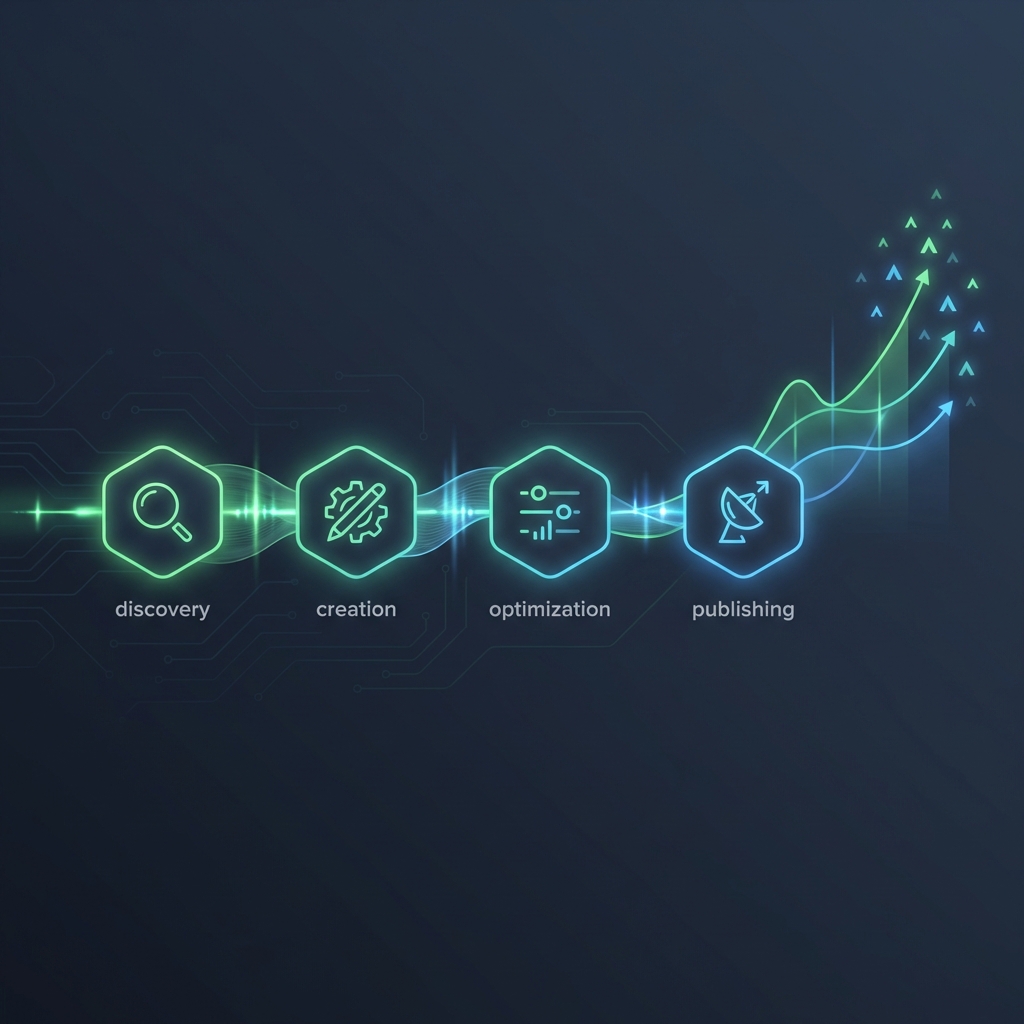
This article walks through every stage of a modern SEO blog automation platform workflow—keyword discovery, AI drafting, on-page optimization, schema markup, CMS publishing, and instant indexing—with full transparency on total cost of ownership.
Two questions drive most buyer evaluations: Will this platform keep content compliant with Google’s E-E-A-T guidelines? And what will it actually cost when all hidden expenses are factored in? Both questions receive direct answers in the sections ahead.
KOZEC serves as the platform demonstrating the live workflow throughout this article, providing concrete examples of how each automation stage functions in practice.
By the conclusion, readers will have a decision framework for evaluating any SEO blog automation platform—not just a feature checklist, but a systematic understanding of what separates genuine end-to-end automation from marketing claims.
Why 2026 Is the Inflection Point for SEO Blog Automation
The question has fundamentally shifted. It is no longer whether to automate SEO workflows, but which aspects of automation matter most and which platforms execute them reliably.
The numbers tell the story clearly: 86% of SEO professionals have integrated AI into their workflows. Manual-only content operations are no longer a quality safeguard—they are a competitive disadvantage. Meanwhile, 87% of businesses now use AI to create SEO content, and companies leveraging AI publish 42% more content monthly than those without AI tools.
The zero-click search reality has transformed what “ranking” means. Sixty percent of all searches in 2026 produce no click due to AI Overviews and optimized snippets. Blog content must now be structured for AI citation, not just blue-link rankings.
Over 2 billion monthly users engage with Google AI Overviews, causing a 61% drop in organic CTR when they appear. This fundamentally changes what automation must deliver. The silver lining: AI-referred traffic converts at 23x higher rates than traditional search traffic, making the ROI case for GEO-aware automation quantifiable.
Gartner’s prediction of a 25% drop in traditional search volume by end of 2026 due to conversational AI means platforms that only optimize for Google rankings are already behind.
With this landscape established, the following sections detail exactly what a complete 2026 automation workflow must include.
The 7-Stage SEO Blog Automation Workflow: From Keyword to Indexed Post
A true end-to-end SEO blog automation platform must execute all seven stages without requiring manual intervention between steps:
- Keyword discovery
- Content brief and topic clustering
- AI drafting
- On-page SEO optimization
- Schema markup
- CMS auto-publishing
- Instant indexing and rank tracking
Most platforms marketed as “automation” only cover stages 2–4, leaving the highest-leverage stages to manual work. This is where hidden costs accumulate.
Stage 1: Keyword Discovery and Competitive Intelligence
True automated keyword discovery differs fundamentally from manual keyword research. The platform scans the connected site, builds a business profile, audits existing content, and identifies competitor keyword gaps—not just a generic keyword list.
KOZEC’s workflow demonstrates this approach: site analysis scans the WordPress site, builds a comprehensive business profile, conducts a content audit of existing material, performs technical SEO analysis, and gathers competitor intelligence before a single keyword is surfaced.
The key differentiator lies in platforms that use actual ranking data and competitor gap analysis versus those generating keyword lists from seed terms alone. The former produces strategically meaningful targets; the latter produces noise.
Bulk keyword upload capability matters for teams with existing keyword research—the ability to import lists directly into the automation pipeline eliminates redundant work.
Critical evaluation criteria include whether the platform maps search intent (informational, commercial, transactional) automatically and whether it clusters related keywords into topic groups to build topical authority rather than isolated posts.
Stage 2: Content Brief Generation and Topic Clustering
A content brief defines structure, target keyword, secondary keywords, competitor references, word count, and content type before AI drafting begins. Without it, AI output remains generic.
Topic clustering for topical authority—grouping related keywords into pillar-and-cluster architectures—signals expertise to Google and increases the likelihood of content appearing in AI Overviews.
KOZEC’s approach centers on business-context-aware content generation, meaning the brief is informed by the site’s specific services, target audience, and brand voice rather than a generic template.
Configurable parameters that matter include word count targets, FAQ inclusion toggles, CTA placement, point of view, and tone settings—all configurable per site, not platform-wide.
Research shows 44.2% of all LLM citations come from the first 30% of a text. Automated briefs should prioritize strong, citable introductory content as a structural requirement.
Stage 3: AI Drafting with Business-Context Awareness
What separates commodity AI writing from platform-grade content generation is the degree to which output reflects the specific business, not just the keyword.
KOZEC demonstrates this through content generated with the client’s services, audience, and brand voice embedded. Meta titles, meta descriptions, internal links, external links, FAQ sections, and CTAs are included automatically in every draft.
Royalty-free image sourcing as an integrated step eliminates the 15–30 minutes per post that manual image selection adds to actual workflows.
AI-written pages now appear in over 17% of top search results, and AI content often begins ranking within two months. Publishing velocity is a legitimate competitive advantage when quality controls are in place.
Stage 4: On-Page SEO Optimization
On-page optimization must function as an automated layer, not an afterthought. Meta titles, meta descriptions, header structure, keyword density, and readability scoring should be applied programmatically before any content reaches the CMS.
SEO plugin integration is a baseline requirement in 2026. KOZEC integrates with Yoast, Rank Math, AIOSEO, SEOPress, and The SEO Framework—content arrives in WordPress with all plugin fields pre-populated.
Smart internal linking means automated internal link optimization that analyzes the existing content library and inserts contextually relevant links to build topical clusters and distribute page authority.
Stage 5: Schema Markup and Structured Data
Schema markup is the most commonly skipped automation stage because it requires technical knowledge most content teams lack. Yet it remains one of the highest-leverage signals for both traditional search and AI citation.
Relevant schema types for blog automation include Article schema, FAQ schema, HowTo schema, BreadcrumbList, and Organization schema. FAQ schema in particular enables rich result display and increases the likelihood of content being surfaced in AI Overviews.
KOZEC’s schema markup and structured data capability is available at the Gold plan ($1,500/month) and above—an important total cost of ownership consideration for buyers who need structured data as part of their workflow.
Stage 6: CMS Auto-Publishing with Full Metadata
CMS auto-publishing is now a baseline expectation, not a premium feature. Any platform requiring copy-paste into a CMS is not a true automation platform—it is an AI writing assistant with extra steps.
KOZEC’s direct WordPress publishing sends content live with full SEO metadata intact, requiring no WordPress login and no manual formatting. This elimination alone saves 20–45 minutes per post.
Configurable publishing schedules—frequency, publishing day, time window, and time zone—should all be configurable independently per connected site.
For regulated industries, draft mode with an approval workflow is not optional; it is a compliance requirement. KOZEC’s approval workflow is available at the Silver plan ($1,000/month) and above.
Stage 7: Instant Indexing, Rank Tracking, and AI Visibility Monitoring
IndexNow protocol integration allows content to be discovered by search engines in hours rather than days or weeks, compressing the time-to-ranking window significantly.
A true automation platform should track keyword rankings, identify underperforming content, and feed that data back into content strategy—not simply report numbers. This closed-loop approach transforms rank tracking from a reporting function into a strategic input.
KOZEC’s performance analytics dashboard tracks traffic, rankings, and conversions. The platform’s compounding intelligence model learns over time which pages convert, which links improve rankings, and which strategies deliver the highest ROI.
The Generative Engine Optimization market is projected to grow from $886 million in 2024 to $7.3 billion by 2031 at a 34% CAGR. Platforms without GEO tracking are already behind the curve.
E-E-A-T Compliance: The Question Every Automation Platform Dodges
Google’s E-E-A-T framework (Experience, Expertise, Authoritativeness, Trustworthiness) is the quality standard for all content—automated or not.
Google explicitly states that using automation to produce content primarily for manipulating search rankings violates spam policies. The operative phrase is “primarily for manipulating”—content that genuinely serves users is not disqualified by being AI-generated.
Where automation helps E-E-A-T: consistent publishing frequency builds topical authority; comprehensive coverage signals expertise; proper citation of authoritative sources supports trustworthiness.
Where automation requires human oversight: experience signals—first-hand knowledge, original perspectives, case studies—cannot be fully automated. This is the layer where editorial review adds irreplaceable value.
KOZEC’s compliance architecture includes an approval workflow available at the Silver plan and above, business-context-aware generation that reduces generic AI output, and configurable tone and voice settings that maintain brand authenticity.
For healthcare, legal, and financial clients—as evidenced by KOZEC’s testimonials from medical sector clients—draft mode with editorial review is not optional. It is the E-E-A-T compliance mechanism.
Total Cost of Ownership: Exposing the Hidden Costs of ‘Affordable’ Platforms
The subscription price is only one component of what an SEO blog automation platform actually costs. Hidden costs can double or triple the effective investment.
The True Cost Components Most Buyers Overlook
Editing and quality control time: Platforms without approval workflows or business-context awareness produce generic content requiring significant editing. At $75–$150 per hour for a skilled editor, 2–3 hours of editing per post on a 30-post-per-month plan adds $4,500–$13,500 per month in hidden labor costs.
Integration complexity: Platforms requiring custom API work, manual CMS setup, or third-party middleware add both setup costs and ongoing maintenance overhead.
Missing feature add-ons: Platforms that charge separately for schema markup, image optimization, or multi-site management can quickly exceed the cost of an all-inclusive higher-tier plan.
Opportunity cost of partial automation: A platform that automates writing but not publishing still requires someone to log into the CMS, format content, add metadata, and publish. At scale, this represents significant labor cost.
KOZEC Pricing vs. True Workflow Cost
Bronze plan ($600/month, 15 articles): Includes AI keyword discovery, automated metadata, internal and external link optimization, royalty-free image sourcing, traffic dashboard, and CMS integration.
Silver plan ($1,000/month, 30 articles): Adds advanced keyword targeting, multi-business dashboard, custom tone and style, approval workflow, and affiliate dashboard.
Gold plan ($1,500/month, 60 articles): Adds competitor mode, schema markup and structured data, enhanced image optimization, white-label option, and priority queue.
Enterprise plan (custom pricing, 100+ articles): Adds custom API integrations, multi-language content strategy, private-label deployment, and a dedicated account strategist.
TCO comparison: KOZEC’s Silver plan at $1,000/month for 30 articles equals $33.33 per article, fully automated. Compare this to freelance writer costs ($150–$300 per article) plus SEO specialist time ($75–$150 per hour for optimization) plus CMS publishing time ($25–$50 per article)—totaling $250–$500 or more per article for a manual workflow. For a detailed breakdown of all available tiers, see KOZEC’s pricing page.
Who Should Use a Full-Automation Platform vs. a Hybrid Approach
Full automation (live publishing mode) is appropriate when:
- The content niche is established and well-understood
- The brand voice is clearly defined and configured in the platform
- The content type consists of lower-stakes informational blog posts
- Publishing volume is high enough that manual review creates a bottleneck
A hybrid approach (draft mode with editorial review) is required when:
- The industry is regulated (healthcare, legal, finance)
- The brand has a highly distinctive voice requiring human refinement
- The content makes specific claims requiring fact-checking
- The audience expects first-hand experience signals
KOZEC’s medical sector testimonials are instructive. Dr. Roy Stoller noted that KOZEC “replaced an entire content workflow” without adding internal resources. For medical practices, the approval workflow at the Silver plan level is the appropriate configuration—not full autopilot.
Results: What to Realistically Expect from SEO Blog Automation
AI content often begins appearing in search results within two months. KOZEC’s reported metric of measurable organic traffic growth within 60–90 days aligns with this benchmark.
Teams using AI for content generation report 60% faster editing processes and 30% improvement in SEO rankings. AI tools help SEO professionals save an average of 12.5 hours per week—quantifiable time savings that translate directly to labor cost reduction.
The compounding content effect distinguishes SEO from paid advertising: a post published in month one continues generating traffic in month twelve without additional spend. At 30 posts per month, the compounding library effect becomes significant within six months. This is the core principle behind how KOZEC turns traffic into revenue through a compounding SEO growth loop.
KOZEC’s reported platform metrics include 1,000+ SEO-optimized articles generated automatically and 100% of connected WordPress sites publishing on autopilot.
Conclusion: The Complete Workflow Is the Competitive Advantage
In 2026, the SEO blog automation platform that wins is not the one with the most features—it is the one that executes the complete 7-stage workflow without requiring manual intervention between steps.
Automation is not inherently non-compliant with Google’s quality guidelines. Low-effort, manipulative automation is. Platforms with business-context awareness, approval workflows, and editorial configuration options are designed for compliance.
The cheapest subscription price is rarely the lowest total cost. Buyers must account for editing time, integration complexity, missing features, and the opportunity cost of partial automation.
KOZEC positions itself as a premium, end-to-end platform best suited for agencies, e-commerce brands, SaaS companies, and local businesses that need consistent, high-volume, automated publishing without adding internal headcount. To learn more about the platform and its approach, visit the KOZEC about us page.
The question is no longer whether to automate—86% of SEO professionals already have. The question is whether the automation platform covers the full workflow or leaves critical stages to manual work that quietly erodes the ROI case.
See the Full Workflow in Action: Schedule a KOZEC Demo
Readers who want to see the complete 7-stage workflow demonstrated live can book a demo at kozec.ai/schedule-a-demo/.
Rather than evaluating features on a pricing page, a live demo shows exactly how KOZEC handles keyword discovery through to indexed post for specific industries and sites.
For readers not yet ready for a demo, KOZEC can be reached by phone at (888) 545-7090 or by email at [email protected] for questions about plan selection and workflow configuration.
For buyers in regulated industries concerned about E-E-A-T compliance, the Silver plan’s approval workflow allows full automation with human editorial review before any content goes live.
KOZEC is built for businesses ready to stop treating content as a manual task and start treating it as a compounding infrastructure investment.
Share
STAY IN THE LOOP
Subscribe to our free newsletter.

With over 15,000 AI marketing solutions on the market, B2B buying committees face unprecedented evaluation complexity in 2026. This structured buyer's guide cuts through the noise with a proven decision framework covering strategic fit, technical requirements, financial justification, and vendor risk. Everything your team needs to choose the right AI content marketing platform with confidence.

SEO Automation for E-Commerce Brands: Category Pages, Product Content, and Blog Pipelines That Scale
Organic search drives 43% of all e-commerce traffic, yet most brands can't capture it at scale with manual workflows. This guide breaks down proven SEO automation strategies for e-commerce brands across category pages, product content, and blog pipelines. Learn what to automate, what to keep human, and how to build a compounding SEO system that grows with your catalog.

Traffic alone no longer tells the full SEO story—especially with AI Overviews cutting organic clicks by 58%. This guide delivers a practical 2026 KPI framework that connects leading indicators like rankings and AI visibility to lagging business outcomes like conversions and revenue. Stop measuring the wrong things and start proving the real value of your content.

Enterprise buyers routinely discover that 30–40% of SEO content platform costs never appear on a vendor's pricing page. This 2026 total cost of ownership guide exposes hidden fees, maps pricing model risk profiles, and delivers a CFO-ready ROI framework. Make smarter procurement decisions before you sign.