
SEO Content Platform With Image Sourcing Automation: The Full-Pipeline Completeness Test for 2026
SEO Content Platform With Image Sourcing Automation: The Full-Pipeline Completeness Test for 2026
July 30, 2026
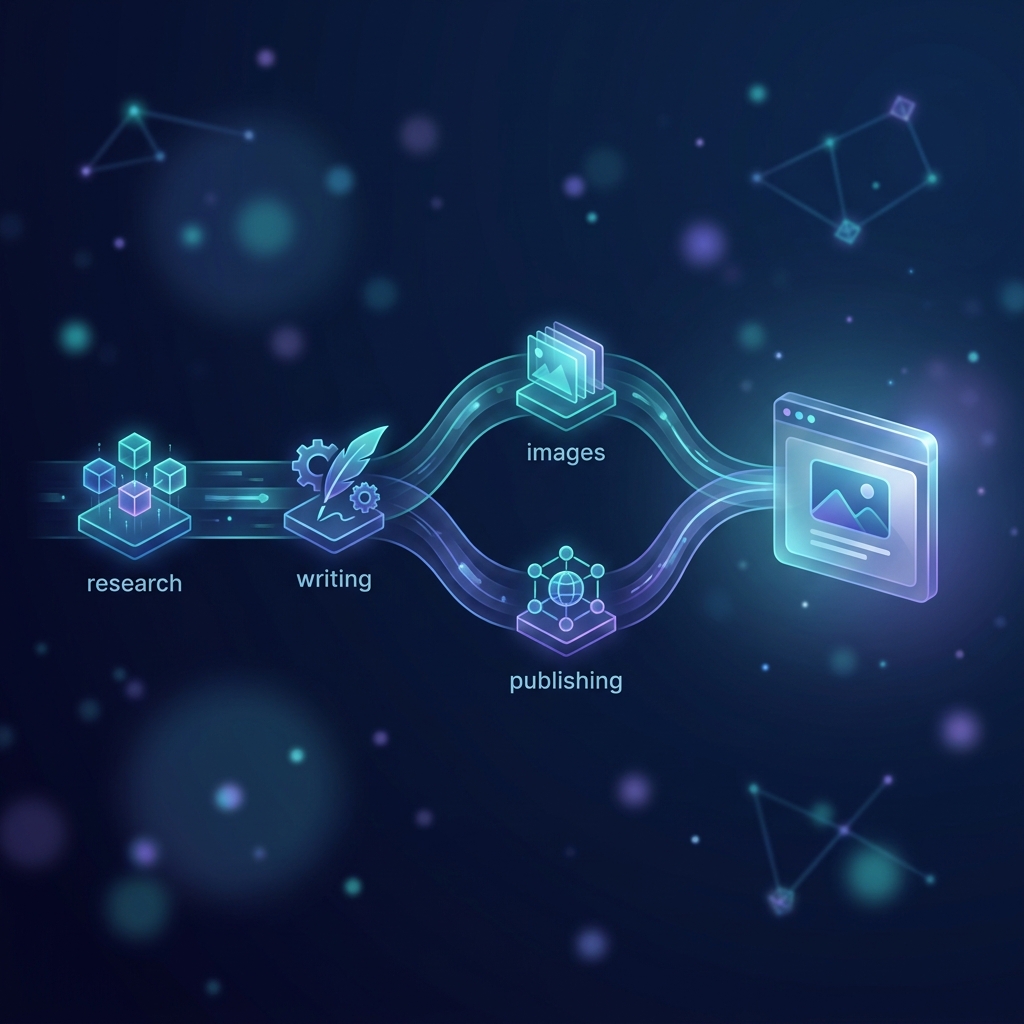
SEO Content Platform With Image Sourcing Automation: The Full-Pipeline Completeness Test for 2026
Introduction: The Finish Line Problem in SEO Content Automation
The SEO software market is worth approximately $96.42 billion in 2026 and is projected to reach $295 billion by 2035 at a 13.26% CAGR (Precedence Research). Yet despite the scale of that investment, most platforms in this space share a quiet, expensive flaw: they stop working before the content is actually publishable.
This is the last-mile friction problem. After the AI generates a polished draft, the workflow does not end. Someone still has to source an image, confirm the license, generate alt text, format it for page speed, and upload the whole thing to the CMS. Image sourcing is the final manual step that silently consumes hours and breaks the momentum of an otherwise automated process.
The stakes are not theoretical. 97% of top-ranking Google pages include at least one image (DemandSage). Image inclusion is not an optional enhancement; it is a baseline competitive requirement.
This article introduces the “pipeline completeness” framework as an objective standard for evaluating any SEO content platform. The thesis is direct: in 2026, only one platform passes the full-pipeline completeness test, and image sourcing automation is the deciding factor. The search for an SEO content platform with image sourcing automation is, in practice, a search for true end-to-end capability, not just another text generator.
What Pipeline Completeness Actually Means in 2026
Pipeline completeness is a measurable standard. It means every step from keyword discovery to published, image-inclusive content is automated without human intervention.
Contrast this with what most tools deliver: end-to-draft automation. These platforms write the article, then hand the remaining steps back to the user. Image sourcing, formatting, metadata, and publishing all become manual again.
Industry research maps the full SEO content workflow as a chain of interlocking tasks: keyword research, competitor analysis, outline creation, draft writing, SEO optimization, meta tag writing, image sourcing, internal link insertion, CMS formatting, and publishing. A single blog post silently expands into 4 to 8 hours of work for a lean team when every step is counted, not just the writing (HypeSuite).
This reveals the core operational insight: the biggest win for a small team is not writing faster. It is eliminating the pile of tasks before and after writing. The pipeline completeness test is therefore binary. Does the platform automate every step listed above, including image sourcing, without requiring a separate tool or manual intervention? Pass or fail.
Why Image Sourcing Is the True Litmus Test for Platform Completeness
Of all the workflow steps, image sourcing is the most revealing gap. It sits at the intersection of content quality, legal compliance, and technical SEO, which makes it uniquely difficult to fake.
The numbers make the case. With 97% of top pages including images, visual content is table stakes. Beyond that, Google Images drives 22.6% of all web search traffic, and Google Lens processes over 12 billion visual queries per month, growing at 30% annually. Image sourcing is not cosmetic; it is a distinct, high-value traffic channel.
There is a technical dimension as well. Unoptimized images are the most common cause of poor Core Web Vitals scores, specifically LCP and CLS, both confirmed Google ranking signals. Automated, properly formatted image sourcing is therefore a technical SEO requirement, not a convenience.
The AI search dimension raises the stakes further. AI Overviews appear in 55% of Google searches and frequently pull in visual content (Companies History). Images with strong alt text and proper optimization are now critical for AI visibility.
Finally, there is the human pain point: 43.8% of marketers cite “producing engaging visual content consistently” as their top challenge (Adobe). Automated image sourcing solves this directly while also removing the licensing risk that manual, ad-hoc sourcing introduces.
The Market Gap: How Most Platforms Fail the Image Sourcing Test
A survey of the competitive landscape exposes a striking pattern. Leading text-focused platforms concentrate exclusively on text generation and keyword optimization. None natively automate image sourcing as part of the content pipeline.
It is important to distinguish two separate problems. Image SEO optimization tools handle alt text, compression, and structured data (ImageSEO). Image sourcing automation is upstream and more friction-heavy: it actually finds and places the image in the first place. Optimization tools do not solve the sourcing problem.
Even the most capable partial-automation platforms fall short. Tools that automate keyword research through CMS publishing do not prominently feature royalty-free image sourcing as a named, built-in capability.
Then there is the DIY workaround trap. Workflow automation tools can technically automate image sourcing via API integrations with Unsplash or Pexels, but they require significant technical setup. This is not pipeline completeness; it is pipeline assembly, with the burden transferred to the buyer.
Enterprise platforms offer image-related features but demand heavy manual coordination and sit priced out of reach for most SMBs.
The market signal is unmistakable: no major competitor explicitly markets image sourcing automation as a core differentiator. This reflects a genuine capability gap, and it persists even as 86% of SEO professionals have implemented AI into their strategy (DemandSage). AI adoption has outpaced pipeline completeness.
The Hidden Cost of the Image Sourcing Gap
The real cost of the gap is workflow fragmentation. The typical process looks like this: write content in one platform, source images manually from Unsplash or Pexels, upload them to the CMS, format everything, then publish. Each handoff is a context switch, and each context switch compounds time loss.
The time savings available are substantial. Users of automated image API integrations report 70 to 80% time savings compared to manual stock photo workflows. Platforms that handle research through publishing cut both context switching and revision cycles simultaneously.
The ROI math supports investing in complete coverage. SEO delivers a median ROI of approximately 748%, and the SEO services market crossed $100 billion in 2026. Paying for incomplete automation, then absorbing the remainder manually, undercuts that return.
For a lean team, the compounding effect is severe. A 1 to 5 person marketing team publishing 15 to 60 pieces per month cannot absorb 4 to 8 hours per post in manual steps. The image sourcing gap alone can consume 15 to 30 or more hours per month. Industry buyer’s guides consistently list image sourcing as a manual bottleneck while failing to recommend any platform that automates it natively, leaving buyers without a clear solution.
Introducing the Full-Pipeline Completeness Test: 8 Stages That Must All Be Automated
The pipeline completeness test is an 8-stage checklist. To qualify as truly end-to-end, a platform must automate all eight. This is an objective evaluation framework, not a product pitch. Any buyer can apply it to any platform under consideration.
Stage 1: Keyword Discovery and Topic Intelligence
Automated keyword discovery means the platform identifies content opportunities based on competitive landscape analysis without requiring manual keyword input. This distinguishes platforms that make users supply keywords from platforms that discover them autonomously. Agentic AI, meaning systems that make strategic decisions without constant prompting, is the standard for this stage in 2026.
Stage 2: Competitor and SERP Analysis
Automated competitor content analysis must be built into the pipeline, not run as a separate research phase. The platform should identify content gaps and angle opportunities without manual SERP review. This stage feeds directly into outline and structure decisions, so automation here multiplies quality downstream.
Stage 3: Structured Content Creation With SEO Optimization
Content must be SEO-optimized at the point of creation, not as a post-generation editing step. Persistent brand context, meaning the platform maintains brand voice and guidelines without starting from scratch each session, is required for consistent output at scale. Metadata such as title tags and meta descriptions must be generated within this stage, not added by hand afterward.
Stage 4: Internal Linking and Content Architecture
Automated internal linking must build topically structured, interlinked content ecosystems rather than isolated pages. This is where most SEO-aware platforms stop: they generate content but never connect it to the broader site architecture. Internal linking is a confirmed ranking signal and a prerequisite for topical authority; it cannot be an afterthought.
Stage 5: Image Sourcing Automation, the Pipeline Completeness Gate
This is the stage where most platforms fail, and the stage that separates end-to-end from end-to-draft. Royalty-free image sourcing must be generated as part of content creation, not added manually afterward (KOZEC Buyer’s Guide).
The infrastructure already exists. The stock image and video API market was valued at approximately $6 billion in 2024, with Unsplash, Pexels, and Pixabay offering programmatic access to millions of royalty-free images (Branding Marketing Agency). The question is whether platforms use it natively. Proper sourcing at this stage must include alt text generation and formatting for Core Web Vitals compliance, not just image selection. Platforms that pass eliminate both the time cost and the legal risk of unlicensed image use.
Stage 6: Structured Data and Technical SEO Elements
Schema markup and structured data optimization must be automated within the pipeline, not treated as a separate technical task. This is increasingly important for AI Overview visibility, since structured data helps AI systems understand and cite content. Platforms that omit this stage force users to supply their own technical SEO expertise or a separate tool.
Stage 7: Direct CMS Publishing
Direct publishing to WordPress and major CMS platforms without manual uploads is a completeness requirement. Compatibility with major WordPress SEO plugins, including Yoast, Rank Math, AIOSEO, SEOPress, and The SEO Framework, is a practical necessity. Platforms that export drafts for manual upload are not pipeline-complete; they have simply pushed the final step back to the user.
Stage 8: Performance Tracking and Continuous Improvement
Completeness extends beyond the first publish. Automated performance monitoring closes the loop between output and strategic refinement. Platforms without this stage require manual analytics review, reintroducing the overhead the platform was supposed to eliminate. Continuous improvement is what separates a publishing tool from a content strategy platform.
KOZEC: The Only Platform That Passes All 8 Stages in 2026
Applying the test to KOZEC produces a clean result across all eight stages. The platform handles business and competitor analysis (Stages 1 and 2), structured content creation with metadata (Stage 3), automated internal linking (Stage 4), native image sourcing (Stage 5), structured data optimization (Stage 6), direct WordPress and CMS publishing (Stage 7), and ongoing performance tracking with continuous improvement (Stage 8).
The distinguishing feature is native image sourcing automation that closes the last-mile gap. The full flow, from keyword discovery through content generation, metadata, linking, image sourcing, and direct WordPress publishing, runs in one connected pipeline (KOZEC ROI). Critically, image sourcing is included from the Foundation plan at $600 per month. It is a baseline capability, not an enterprise add-on.
This is possible because KOZEC uses agentic AI that operates continuously in the background rather than requiring manual management or constant prompting. Its SCO (Search Compliance Optimization) framework applies Google’s recommended best practices at every stage, not just at content generation. Its GEO (Generative Engine Optimization) approach structures content for AI-generated results, including Google AI Overviews and chat assistants, which matters given that AI Overviews now appear in 55% of searches.
Reported performance metrics frame these outcomes: +215% organic traffic increase, +287% traffic value growth, +621% keyword visibility increase, and +386% AI Overview citation growth. Pipeline completeness does not mean loss of control, either. An optional review and approval workflow lets businesses govern tone, structure, publishing cadence, and strategy while still benefiting from full automation.
Pipeline Completeness vs. Partial Automation: The Real Cost Comparison
Three scenarios illustrate the difference.
- Traditional SEO agency: $8,000 to $15,000 per month for 8 to 12 articles, with 4 to 8 week onboarding and no image sourcing automation. Highest cost, slowest deployment.
- Partial automation platform (text only): Lower monthly cost, but requires manual image sourcing, CMS formatting, and publishing. The hidden time cost runs 15 to 30 or more hours per month for a lean team.
- Pipeline-complete platform (KOZEC): $600 to $1,500 per month for 15 to 60 or more articles, with full automation including image sourcing. Lowest cost per published, image-inclusive piece.
The correct metric is true cost per published piece: not cost per draft, but cost per fully formatted, image-inclusive, published, and indexed piece of content. With roughly 68% of digital marketers already adopting AI-based SEO tools, most are already paying for AI, but most of those tools are not pipeline-complete. Organizations are paying for partial automation and absorbing the remainder manually. Against an average SMB spend of $900 to $2,700 per month on AI marketing tools in 2026, a pipeline-complete platform priced at $600 to $1,500 with image sourcing included is competitive while eliminating tool-stacking overhead.
Who Needs a Pipeline-Complete SEO Content Platform With Image Sourcing Automation
The primary buyer is a growth-stage business with revenue traction but a lean marketing team of 1 to 5 people: one that cannot afford full agency retainers yet needs more than ad-hoc AI tools.
- Digital agencies managing multiple client sites: image sourcing automation multiplies per-client capacity without adding headcount.
- B2B SaaS companies: consistent, image-inclusive publishing is a competitive requirement in crowded search landscapes. An organic traffic strategy for SaaS companies depends on exactly this kind of pipeline completeness.
- E-commerce and DTC brands: product-adjacent content with proper images drives both organic traffic and AI Overview citations.
- Multi-location and franchise brands: scale requires automation that handles image sourcing consistently across every location.
The common thread is straightforward. Any organization where content volume requirements exceed the team’s manual capacity is a candidate, and image sourcing is typically the first manual step to become a bottleneck at scale. With 94% of marketers planning to use AI in content creation in 2026, the question is no longer whether to use AI. It is whether the AI platform is pipeline-complete.
How to Evaluate Any SEO Content Platform for Pipeline Completeness
Buyers can apply this checklist to any platform under consideration:
- Does it automate keyword discovery without manual input?
- Does it include image sourcing as a named, built-in feature, not a third-party integration requirement?
- Does it publish directly to the CMS without manual upload?
- Does it generate metadata and structured data automatically?
- Does it build internal links across the content ecosystem?
Several red flags warrant attention. Platforms that describe image sourcing as “supported via integration” require manual setup. Platforms that export drafts rather than publishing directly have shifted the final step back to the user. Platforms that require separate tools for metadata or schema are incomplete by definition.
Buyers should also beware the integration trap. A platform that needs API integration or custom API work to source images is not pipeline-complete; it has transferred the technical burden to the buyer. The best diagnostic is a workflow demonstration: watch a keyword enter the system and a fully published, image-inclusive piece exit with no manual steps in between. One additional signal: platforms that require 4 to 8 weeks to onboard are usually not complete, because they require extensive manual configuration to compensate for gaps. Pipeline-complete platforms should be operational within days.
The Future of Pipeline Completeness: What 2026 and Beyond Demands
The broader AI search shift raises the stakes. AI Overviews now appear in 55% of searches, and AI-sourced traffic converts at 4 to 5 times the rate of traditional organic traffic. The reward for complete, optimized content pipelines is growing.
Visual search reinforces the point. With Google Lens processing 12 billion visual queries per month and growing at 30% annually, image sourcing automation will become more strategically important, not less. Content volume pressure adds another layer: AI content platforms produce 4.6 times more content per marketer per month, but only if the pipeline is complete enough to handle that volume without reintroducing manual steps. Teams at Level 3 AI maturity produce 5 to 10 times more content at 75 to 85% lower cost per article, and pipeline completeness, including image sourcing, is what enables that maturity level.
This represents a durable competitive moat. Organizations that achieve full-pipeline automation in 2026 will compound their content advantage over competitors still managing manual image workflows. As generative search becomes the primary discovery mechanism, content consistently published with proper images, alt text, and structured data will hold a structural advantage in AI citation.
Conclusion: The Last Mile Is the Whole Race
Pipeline completeness is not a checklist item. It is the difference between a platform that automates content creation and a platform that automates content outcomes.
The image sourcing argument is decisive: 97% of top-ranking pages include images, 43.8% of marketers struggle to produce visual content consistently, and 70 to 80% time savings are available through automation. Yet most platforms leave this step manual. The completeness test names eight stages that must all be automated without human intervention, with image sourcing as the gate most platforms fail.
KOZEC is the only SEO content platform in 2026 that passes all eight, with image sourcing automation included from the Foundation plan at $600 per month. In a market where 86% of SEO professionals have adopted AI tools but most of those tools stop before the finish line, the advantage belongs to organizations that demand true pipeline completeness. The last mile of content automation is not a convenience feature. It is the whole race.
Ready to Run a Pipeline-Complete SEO Content Operation?
See the full pipeline in action. Schedule a demo at kozec.ai/schedule-a-demo/ to watch a keyword travel from discovery to published, image-inclusive content with no manual steps in between.
For readers who want to benchmark their current workflow first, the KOZEC Automated SEO Content Platform Buyer’s Guide provides a framework to evaluate any operation against the pipeline completeness standard before booking.
The entry point is low-risk: no long-term contracts, setup in days rather than months, and a Foundation plan at $600 per month that includes image sourcing automation. The full pipeline is accessible without enterprise commitment. To speak with someone directly, call (888) 545-7090 or visit kozec.ai.
KOZEC is built for growth-stage businesses that need professional-grade content outcomes without agency-level budgets or manual-step overhead: pipeline completeness at a price point that makes the ROI case obvious.
Stay In The Loop
Subscribe to our free newsletter.
Stop Managing SEO - Start Scaling It
Let KOZEC handle strategy, content, and execution - so you can focus on growth.
Automated SEO content for growing agencies.
KOZEC helps agencies, consultants, and growing brands publish high-quality SEO content on autopilot — so your site ranks higher and converts more visitors.
Managing SEO content for many client websites doesn’t scale with traditional methods. Writers are expensive and inconsistent, keyword research is time-consuming, and publishing requires multiple manual steps. As agencies grow, maintaining both quality and consistency becomes increasingly difficult. KOZEC (Keyword Optimized Zero Effort Content) solves this by automating analysis, keyword discovery, content creation, and publishing—so your clients get reliable SEO content while your team focuses on growth.
Increase organic traffic without manual content creation
Publish keyword-optimized posts automatically to WordPress
Turn SEO into a predictable, scalable growth channel