
How to Automate WordPress Blog Publishing: The 3-Tier Stack Decision Framework for 2026
How to Automate WordPress Blog Publishing: The 3-Tier Stack Decision Framework for 2026
June 6, 2026
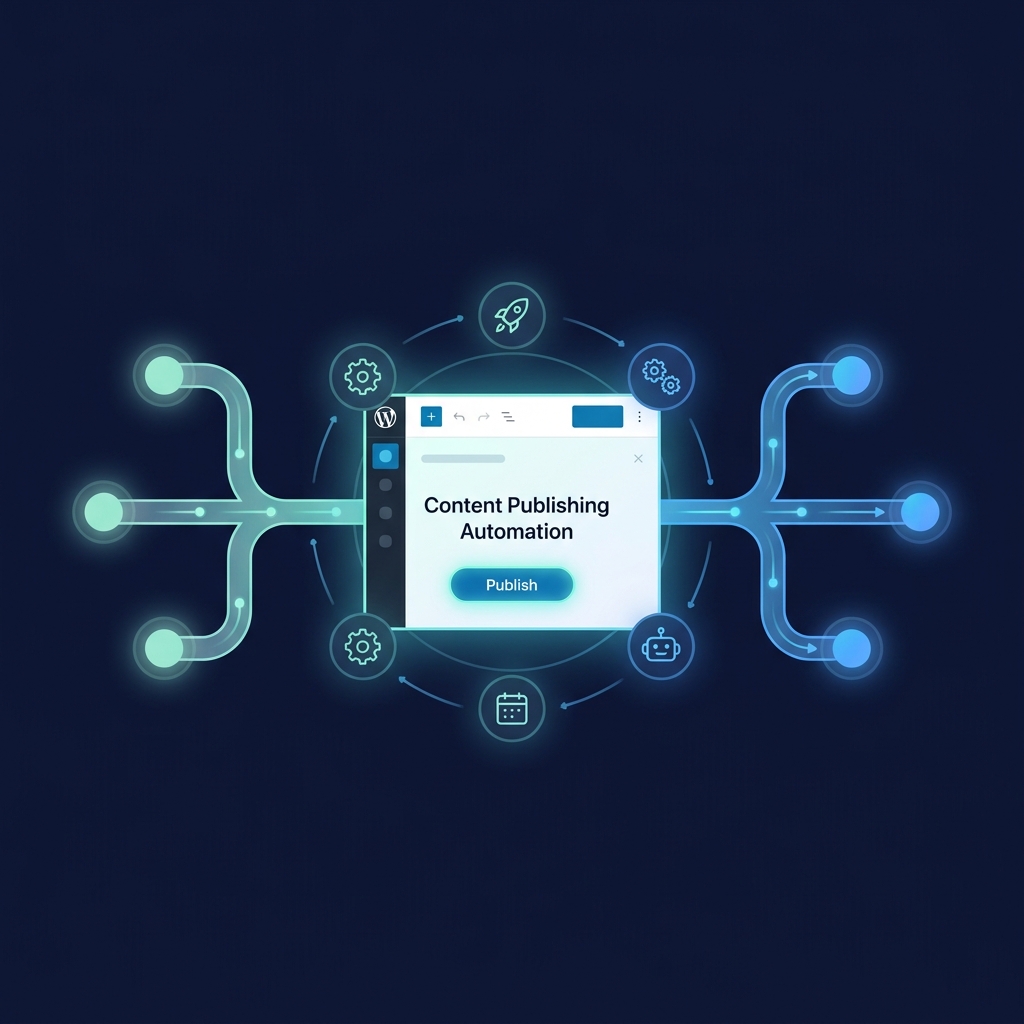
How to Automate WordPress Blog Publishing: The 3-Tier Stack Decision Framework for 2026
Introduction: The WordPress Publishing Bottleneck Most Businesses Never Solve
WordPress powers 43.5% of all websites and holds 62.8% of the CMS market in 2026. This dominance means publishing automation has its highest-impact opportunity on this platform above all others. Yet most businesses remain trapped in manual workflows that drain hours from every content cycle.
The numbers tell a sobering story. Pasting content, reformatting headings, adding images, setting SEO metadata, assigning categories, and hitting publish can consume one to three hours per post. For teams publishing at volume, this overhead becomes crippling. The content creation problem has been solved by AI. The publishing pipeline has not.
Existing guides on WordPress automation share a common flaw: they treat publishing automation as a single-solution problem. They recommend either the Schedule button, a plugin, or an API integration without helping readers choose the right approach for their situation. This one-size-fits-all mentality leaves businesses either under-investing in automation or over-engineering solutions they cannot maintain.
This article introduces the 3-Tier Stack Decision Framework: a structured decision model that maps native scheduling, plugin-based automation, and AI-powered end-to-end platforms to three critical variables. Those variables are publishing volume, technical skill level, and SEO requirements.
By the end of this guide, readers will know exactly which tier fits their operation and when they have outgrown it. The stakes are significant. Marketing automation delivers an average $5.44 return for every $1 invested over three years, with 76% of companies achieving positive ROI within the first year.
Why WordPress Publishing Automation Matters More in 2026
The content creation bottleneck has shifted. With 80% of marketers now using AI for content creation and AI content platforms producing 4.6x more content per marketer per month, manual publishing workflows have become the new constraint. Content generation speed has outpaced content distribution infrastructure.
The emergence of Generative Engine Optimization (GEO) adds urgency. AI Overviews now appear on 48% of Google queries as of April 2026, up from 31% in February 2025. Consistent, structured, high-frequency publishing is no longer optional for search visibility. Businesses that cannot publish at scale cannot compete for AI-driven search real estate.
The compounding effect is substantial. Teams at Level 3 AI maturity produce five to ten times more content at 75% to 85% lower cost per article. However, this advantage only materializes when the publishing pipeline matches the content generation speed. A team generating 60 articles per month but manually publishing 20 gains nothing from their content production capability.
Publishing automation is no longer a time-saving tactic; it is competitive infrastructure. While 92% of marketers use automation for data analysis and reporting, far fewer have automated the publishing pipeline itself. This gap represents the opportunity this framework addresses.
Understanding the 3-Tier Stack: A Framework Overview
The three tiers are defined as follows:
Tier 1: Native WordPress Scheduling uses the built-in Schedule button in the WordPress editor. No plugins or coding required.
Tier 2: Plugin-Based Automation extends WordPress with editorial calendars, social distribution, and workflow management through plugins like Uncanny Automator, CoSchedule, or Blog2Social.
Tier 3: API and AI-Powered End-to-End Automation operates at the WordPress REST API level, enabling programmatic content creation, SEO metadata injection, and publication through platforms like Zapier, Make, n8n, or dedicated AI publishing systems.
These tiers are not a hierarchy of quality. They represent a spectrum of complexity, volume capacity, and technical investment. The three decision variables that determine the appropriate tier are publishing volume (posts per week or month), technical skill level of the team, and SEO requirements (basic metadata versus full field-mapping and structured data).
A simple decision preview: a solo blogger publishing two to three times per week with no developer resources fits Tier 1. A growing team needing scheduling, editorial calendars, and social distribution fits Tier 2. A growth-stage business needing AI-generated, SEO-optimized, auto-published content at scale requires Tier 3.
Many businesses currently operate at the wrong tier. Some under-invest by using only native scheduling when they need plugin workflows. Others over-complicate by building custom API integrations when a platform solution exists.
Tier 1: Native WordPress Scheduling
Native scheduling works through the built-in Schedule button in the WordPress block editor. Users select a future date and time, and WordPress queues the post for publication. No plugins or coding required.
The ideal use case is solo bloggers or small sites publishing two to three posts per week who need basic time-based publishing without additional complexity.
However, native scheduling carries a hidden reliability problem. WordPress’s wp-cron system is not a true server-side cron job. It only triggers when a site visitor loads a page. This means low-traffic sites regularly experience “Missed Schedule” errors. A post scheduled for Monday at 9 AM may not publish until the next visitor arrives, which could be hours later.
Three fixes exist for the wp-cron problem. First, replace wp-cron with a real server-side cron job via the hosting control panel. Second, use a dedicated plugin like “Missed Scheduled Posts Publisher.” Third, move to an external automation platform that runs independently of site traffic.
Tier 1 has hard limits: no SEO metadata automation, no social distribution, no AI content integration, no multi-site support, and no editorial workflow management. It is scheduling only.
Verdict: Tier 1 is the right starting point but has a clear ceiling. When publishing frequency exceeds three to four posts per week or SEO metadata becomes a priority, it is time to move to Tier 2.
The wp-cron Problem: A Deeper Look at WordPress’s Hidden Scheduling Flaw
The technical root cause is straightforward. WordPress’s wp-cron system is a pseudo-cron that piggybacks on page load events rather than running on a server timer. This design choice was made for shared hosting compatibility but creates reliability problems at scale.
The “Missed Schedule” error manifests practically: WordPress marks the post as missed, it remains in draft or scheduled state, and the publisher often does not discover the failure until manually checking.
The server-side cron fix requires disabling wp-cron in wp-config.php by adding define('DISABLE_WP_CRON', true); then setting up a real cron job via cPanel, Plesk, or server SSH to call wp-cron.php at defined intervals.
Many managed WordPress hosts (WP Engine, Kinsta, Flywheel) handle this at the infrastructure level. Checking with the hosting provider before implementing manual fixes is worthwhile.
This matters for automation at scale because a single wp-cron failure can cascade into multiple missed publications when a business publishes 30 to 60 posts per month via automated pipelines. This breaks editorial cadence and SEO consistency.
This reliability problem is one of the primary reasons high-volume publishers move to Tier 3 platforms that publish via the REST API on their own server infrastructure, bypassing wp-cron entirely.
Tier 2: Plugin-Based Automation
Tier 2 extends WordPress’s native scheduling into a full editorial workflow system. Plugins add features like editorial calendars, social auto-distribution, conditional publishing logic, and multi-channel coordination.
The ideal use case is growing content teams publishing 5 to 20 posts per month who need workflow management, social distribution, and basic automation without hiring developers.
Leading plugin categories include editorial calendar and scheduling plugins, workflow automation plugins, and social distribution plugins, such as WP Scheduled Posts, PublishPress Planner, CoSchedule, Uncanny Automator, OttoKit/SureTriggers, Blog2Social, and Jetpack Social.
Editorial calendar and scheduling plugins such as WP Scheduled Posts, PublishPress Planner, and CoSchedule provide visual calendars and team collaboration features.
Workflow automation plugins like Uncanny Automator (connecting 220+ plugins and apps, with a built-in AI agent launched in April 2026) and OttoKit/SureTriggers (1,200+ app integrations) enable complex conditional workflows.
Social distribution plugins including Blog2Social and Jetpack Social automate sharing to social platforms upon publication.
OttoKit offers a key advantage: because it runs automations on its own server rather than relying on wp-cron, it fires reliably even when no visitors are on the site. This solves the core Tier 1 reliability problem.
Uncanny Automator’s April 2026 AI agent capability (the “Uncanny Agent”) reads site content and user data before acting, enabling context-aware automation triggers that go beyond simple time-based scheduling.
However, Tier 2 has an SEO metadata gap. Most scheduling plugins do not natively map SEO fields to Yoast or Rank Math custom fields. This requires either manual metadata entry or a separate SEO plugin workflow, creating a process gap for automated content.
Tier 2’s limits become apparent when plugin stacks grow unwieldy. Three to five plugins managing different workflow parts can create plugin conflicts, add page load overhead, and still require human content creation and manual SEO optimization.
Verdict: Tier 2 is the right solution for teams that have outgrown native scheduling but are not yet publishing at a volume that justifies API-level automation. The ceiling is reached when content creation itself needs to be automated, not just the scheduling.
Tier 3: API and AI-Powered End-to-End Automation
Tier 3 automation operates at the WordPress REST API level, enabling programmatic content creation, SEO metadata injection, image assignment, category tagging, and publication without touching the WordPress dashboard.
The WordPress REST API, available since WordPress 4.7, allows any system capable of HTTP requests and JSON parsing to create, update, and publish posts programmatically. This is the technical backbone of all modern high-volume automation.
The ideal use case is growth-stage businesses, agencies, and enterprise teams publishing 30 to 100+ posts per month who need AI-generated, SEO-optimized content published automatically at scale.
Three no-code and low-code platform options dominate this tier: Zapier, Make (formerly Integromat), and n8n. Zapier offers 7,000+ integrations and is easiest for non-technical users, though it carries the highest per-task cost at volume. Make provides approximately 1,500 integrations with a visual workflow builder at lower cost, making it better for complex multi-step pipelines. n8n is open-source and self-hostable with unlimited executions, making it best for AI agent workflows and privacy-sensitive teams.
Zapier offers 7,000+ integrations and is easiest for non-technical users, though it carries the highest per-task cost at volume.
Make (formerly Integromat) provides approximately 1,500 integrations with a visual workflow builder at lower cost, making it better for complex multi-step pipelines.
n8n is open-source and self-hostable with unlimited executions, making it best for AI agent workflows and privacy-sensitive teams.
The n8n platform offers a published workflow template that automatically generates and publishes 10 blog posts per day to WordPress by collecting RSS feeds, filtering for relevance, expanding with AI research, generating images via Leonardo AI, and publishing via the WordPress REST API.
The multi-agent AI publishing model represents the frontier of Tier 3. Agent 1 researches topics and identifies content gaps. Agent 2 writes SEO-structured content. Agent 3 edits for quality and brand voice. Agent 4 optimizes metadata and internal links. The pipeline then auto-publishes. This approach treats AI as a full publishing orchestrator rather than a writing assistant.
One practitioner reported saving approximately 10 hours per week by automating two multilingual blogs using the WordPress REST API with Node.js, writing in Markdown locally and publishing with a single CLI command.
Security architecture for Tier 3 relies on WordPress Application Passwords (introduced in WordPress 5.6) as the recommended authentication method for REST API integrations. OAuth 2.0 is used for third-party app connections. Teams should evaluate the data privacy implications of routing WordPress credentials through third-party cloud automation platforms.
The Critical SEO Metadata Field-Mapping Problem
This is the most commonly missed step in automated publishing. When content is published via the REST API without explicit metadata field mapping, the post goes live with no SEO title, no meta description, and no structured data. It is technically published but SEO-invisible.
The specific custom fields for major SEO plugins are:
- Yoast SEO:
_yoast_wpseo_titleand_yoast_wpseo_metadesc - Rank Math:
rank_math_titleandrank_math_description - AIOSEO, SEOPress, and The SEO Framework: each have their own field naming conventions
These fields are submitted as part of the “meta” object in the JSON payload alongside the post content, title, status, categories, and featured image ID.
Incorrect or missing field mapping means SEO metadata never reaches the live site. The automation appears to work (the post publishes) but the SEO benefit is lost entirely.
A post-publication automation layer can amplify results: automating IndexNow protocol notifications to Bing, Yandex, and other participating search engines can dramatically reduce the time between publication and indexing.
End-to-end platforms like KOZEC handle this field mapping natively. SEO metadata is generated as part of the content creation workflow and injected correctly at publication, eliminating the mapping problem entirely.
The Quality Gate Question: When Should Automated Content Auto-Publish vs. Await Human Review?
This is the most strategically important decision in any automation implementation. The quality gate determines whether automation accelerates growth or creates a liability.
A quality gate is an automated threshold check that evaluates content against defined criteria before deciding whether to publish immediately or route to a human reviewer.
Key quality gate criteria include:
- Readability score (Flesch-Kincaid or similar)
- Keyword optimization level (target keyword present in title, H1, first paragraph, and meta description)
- Internal link count (minimum threshold for topical authority building)
- Content length (minimum word count for the target topic)
- Image presence (featured image assigned)
Content that meets all thresholds auto-publishes on schedule. Content that fails one or more criteria is flagged and routed to a human reviewer with specific notes on what needs correction.
The human-in-the-loop hybrid model is not an all-or-nothing choice. The most effective implementations use full automation for high-confidence content (evergreen topics, established templates) and human review gates for sensitive topics, breaking news, or content targeting high-competition keywords.
KOZEC’s optional review and approval workflow (available on the Momentum tier and above) implements exactly this model. Businesses retain control over publication decisions while the AI handles all content production and formatting.
Practical recommendation: Start with human review on all automated content, establish quality benchmarks from the first 20 to 30 posts, then configure quality gate thresholds based on observed performance patterns before enabling auto-publish.
How to Choose the Right Tier: A Decision Framework
The decision framework evaluates three variables:
Volume decision branch:
- Fewer than 4 posts per week: Tier 1 is sufficient
- 5 to 20 posts per month with social distribution needs: Tier 2
- 20+ posts per month or AI-generated content pipelines: Tier 3
Technical skill decision branch:
- No developer resources and no budget for technical setup: Tier 1 or Tier 2 plugins
- Comfort with no-code platforms (Zapier/Make): Tier 2/3 hybrid
- Developer on team or open to managed platform: full Tier 3
SEO requirements decision branch:
- Basic publishing with manual SEO: Tier 1 or 2
- Automated metadata with Yoast/Rank Math field mapping: Tier 2 with SEO plugin or Tier 3
- Full SEO automation including structured data, internal linking, and GEO optimization: Tier 3 platform
Many businesses run Tier 1 plus Tier 2 combinations (native scheduling plus three to four plugins) that create maintenance overhead, plugin conflicts, and workflow gaps. The decision framework helps identify when consolidating to a Tier 3 platform is more efficient than adding another plugin.
Migration signal checklist: Signs that a business has outgrown its current tier include spending more than 2 hours per post on publishing tasks, experiencing wp-cron failures, manually entering SEO metadata for every post, being unable to maintain publishing consistency due to team bandwidth, or needing to publish in multiple languages.
Tier selection is not permanent. Businesses should reassess their tier every 6 to 12 months as publishing volume, team size, and SEO sophistication evolve.
KOZEC: The Tier 3 Solution Built for Growth-Stage Businesses
For businesses that have identified themselves as Tier 3 candidates through the decision framework, KOZEC represents the logical destination. The platform is specifically designed for growth-stage businesses with lean marketing teams (typically one to five marketers) that need professional-grade output without enterprise-level budgets.
KOZEC’s end-to-end automation scope covers the complete workflow: business and competitor analysis, topic discovery, content gap identification, structured content creation, SEO metadata generation, internal linking, image sourcing, and direct WordPress publishing. No manual intervention is required at any step.
The platform addresses the SEO metadata problem directly by natively integrating with Yoast, Rank Math, AIOSEO, SEOPress, and The SEO Framework. SEO metadata is generated as part of the content creation process and correctly field-mapped at publication, eliminating the most common Tier 3 implementation failure.
KOZEC’s proprietary SCO (Search Compliance Optimization) framework focuses on Google-recommended practices: useful content, clear page structure, smart internal links, and consistent publishing cadence. This aligns with the 2026 search environment’s emphasis on genuine content quality rather than algorithmic shortcuts.
The platform also addresses the GEO dimension by structuring content specifically for visibility in Google AI Overviews, ChatGPT, Perplexity, and other generative search experiences. This capability goes beyond traditional SEO automation and addresses the 48% of Google queries now showing AI Overviews.
The cost comparison is stark. Traditional SEO agencies charge $8,000 to $15,000 per month for 8 to 12 articles. KOZEC delivers 15 to 60+ articles per month at $600 to $1,500 per month with automated publishing, SEO optimization, and performance tracking included.
Early users report significant results: +215% organic traffic increase, +287% traffic value growth, +621% keyword visibility increase, and +386% AI Overview citation growth. Measurable results typically appear within 60 to 90 days.
Setup deploys in days, not months, eliminating the 4 to 8 week agency onboarding delay that costs businesses critical publishing momentum.
Implementation Considerations: Security, Privacy, and Multi-Site Management
WordPress Application Passwords (available since WordPress 5.6) are the recommended method for authenticating REST API integrations. They can be generated per integration, scoped to specific capabilities, and revoked without changing the main account password.
Agencies and enterprise teams managing multiple WordPress installations can use the REST API to publish to multiple sites simultaneously from a single automation pipeline. This capability is high-value and difficult to replicate with plugin-based solutions.
Automating IndexNow protocol notifications after each publication event notifies Bing, Yandex, and other participating search engines immediately, reducing indexing lag from days to hours for new content.
Content decay monitoring represents a post-publication automation layer worth considering: tracking performance metrics per post and triggering update workflows when content drops below traffic thresholds completes the full content lifecycle automation. Understanding how to measure SEO content performance is essential for configuring these thresholds effectively.
Conclusion: Matching Automation Tier to Business Stage
The core framework is straightforward. Tier 1 (native scheduling) serves solo publishers with low volume and no technical requirements. Tier 2 (plugin-based) serves growing teams needing workflow management and social distribution. Tier 3 (API/AI-powered platforms) serves growth-stage businesses that need AI-generated, SEO-optimized content published automatically at scale.
The key insight separating this guide from comparable resources is that the right tier is determined by publishing volume, technical skill level, and SEO requirements, not by which solution is most technically impressive.
Any business experiencing Missed Schedule errors, publishing inconsistency, or SEO metadata gaps should treat these as clear signals to move up a tier.
Automation without quality controls is a liability. The human-in-the-loop model is not a compromise; it is the professional standard for responsible high-volume publishing.
The businesses winning in the 2026 search landscape are not the ones publishing the most content manually. They are the ones that have built publishing infrastructure that scales with their ambitions.
Ready to Move Beyond Manual Publishing? See How KOZEC Automates Your Entire WordPress Content Pipeline
For readers who identified as Tier 3 candidates through the decision framework, the next step is clear: schedule a demo at kozec.ai/schedule-a-demo/ to see the end-to-end automation workflow in action.
The entry point carries minimal risk. No long-term contracts, cancel anytime, setup in days. The Foundation plan at $600 per month provides 15 content pieces with full WordPress publishing, SEO metadata automation, internal linking, image sourcing, and performance tracking included. This is a complete Tier 3 implementation at a fraction of agency cost.
For readers who want to discuss their specific situation before committing, contact options include phone at (888) 545-7090 or the demo booking page.
For those not yet ready for a demo, reviewing KOZEC’s pricing page allows comparison of tiers against current publishing volume to identify which plan aligns with the business’s growth stage.
Stay In The Loop
Subscribe to our free newsletter.
Stop Managing SEO - Start Scaling It
Let KOZEC handle strategy, content, and execution - so you can focus on growth.
Automated SEO content for growing agencies.
KOZEC helps agencies, consultants, and growing brands publish high-quality SEO content on autopilot — so your site ranks higher and converts more visitors.
Managing SEO content for many client websites doesn’t scale with traditional methods. Writers are expensive and inconsistent, keyword research is time-consuming, and publishing requires multiple manual steps. As agencies grow, maintaining both quality and consistency becomes increasingly difficult. KOZEC (Keyword Optimized Zero Effort Content) solves this by automating analysis, keyword discovery, content creation, and publishing—so your clients get reliable SEO content while your team focuses on growth.
Increase organic traffic without manual content creation
Publish keyword-optimized posts automatically to WordPress
Turn SEO into a predictable, scalable growth channel