
AI Visibility Solutions With Best Generative Engine Optimization: Native GEO vs. Retrofit
AI Visibility Solutions With Best Generative Engine Optimization: Native GEO vs. Retrofit
September 28, 2026
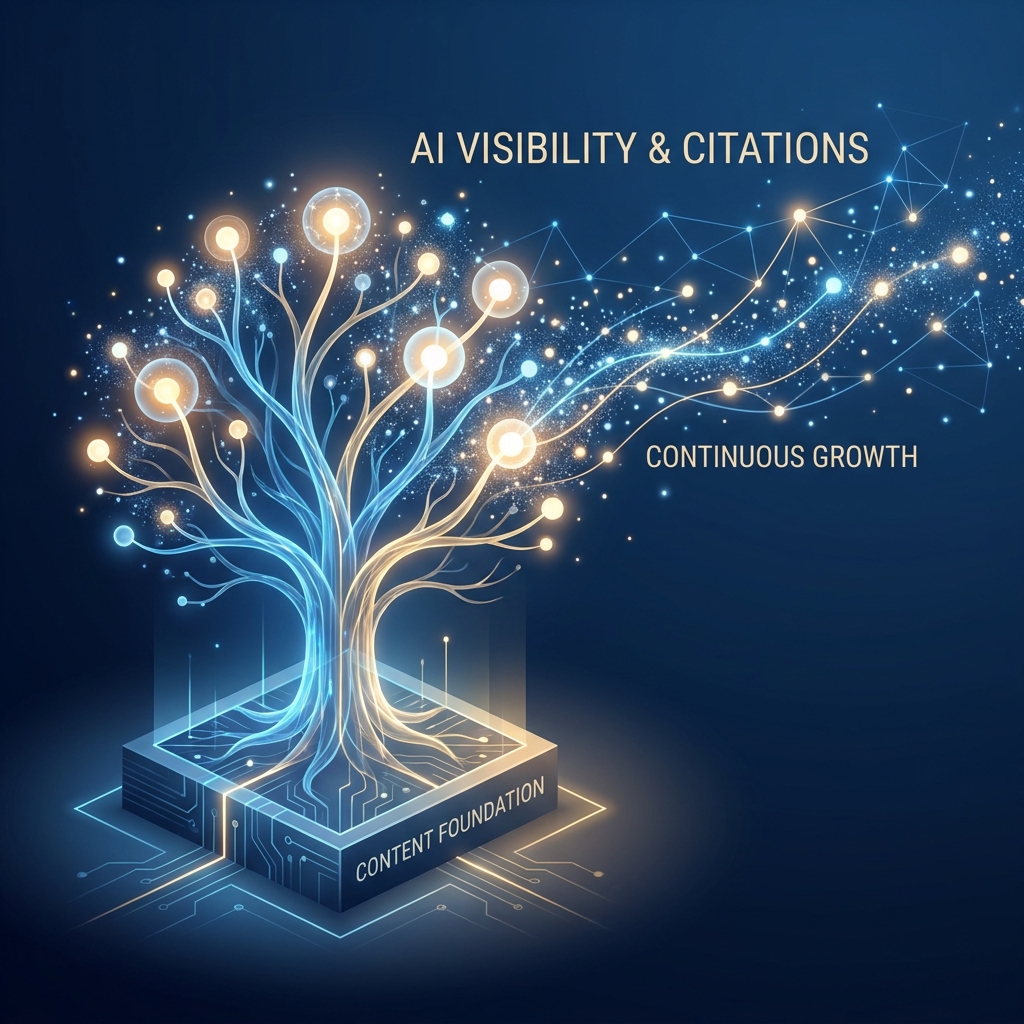
AI Visibility Solutions With Best Generative Engine Optimization: Native GEO vs. Retrofit
Introduction: Why Most “AI Visibility Solutions” Comparisons Are Asking the Wrong Question
The way people find information has changed. According to Semrush data cited in industry reports, AI search traffic grew 527% year over year while traditional organic search declined 2.5% in the same period. Industry data shows that AI Overviews now appear on 48% of Google queries, up from 31% in February 2025. Discovery increasingly happens inside generated answers, not on traditional results pages.
Marketing leaders have noticed. Roughly 98% of CMOs now invest in some form of AI search optimization, yet 92% of brands are reported to still be failing at GEO execution. No feature checklist explains a gap that wide.
This article takes a different approach from the typical ranked list. Instead of comparing tools on dashboards and pricing, it serves as an architecture audit. The central question: does a solution merely watch AI answers, or does it produce the content that earns citations inside them?
The core finding is that the market splits into two camps: retrofit SEO suites and monitoring-only GEO point solutions. Both stop short of the full monitor, create, publish, and remeasure loop. With Dimension Market Research valuing the GEO market at about $1.09 billion in 2026 and projecting $17.15 billion by 2034 (a 40.6% CAGR), the cost of choosing the wrong architecture will only grow.
The AI Visibility Market Has a Vendor Proliferation Problem
G2’s first AEO Grid Report launched in December 2025 with nine products. By April 2026, the category had grown to 248 listed products. That growth makes feature-matrix comparisons increasingly unreliable, because nearly every vendor now claims “AI visibility tracking” as a checkbox. When everyone checks the same boxes, the real differentiator becomes architecture, not feature count.
Why “Best” Lists Fail Buyers
Most published buyer’s guides rank 8 to 22 tools on pricing and dashboard design, organized almost entirely around monitoring capability. They rarely ask whether a tool can act on what it finds. Readers walk away with a shortlist but no decision framework. This article corrects that gap by evaluating how each category is built and what it can actually do.
The Terminology Fog: GEO, AEO, LLMO, and AIO
The vocabulary is fragmented. Generative engine optimization (GEO) overlaps with answer engine optimization (AEO), large language model optimization (LLMO), and AI optimization (AIO), with no consensus definition across vendors. For buyers, the terms collapse into one question: can the solution influence what generative engines cite and say about a brand? The academic research presented at KDD 2024, covered below, provides a common reference point that cuts through vendor jargon.
The Architecture Audit Framework: Two Axes Every Buyer Should Apply
A simple two-axis model clarifies the landscape:
- Monitoring Depth: Does the solution track AI citations natively, using a prompt-first design?
- Execution Capability: Does it create and publish the content needed to earn those citations?
Most vendors occupy only one axis, which is why the market naturally segments into retrofit suites and native monitoring tools.
Axis One: Native AI Citation Monitoring vs. Bolted-On Tracking
Native monitoring means prompt-level query simulation across ChatGPT, Gemini, and Perplexity, not repurposed keyword-rank data. The distinction is mechanical. ChatGPT alone has more than 800 million weekly active users and processes over 1 billion queries per day. Those queries are conversational and highly variable, so tracking built around fixed keywords captures only a fraction of how real users ask questions.
Axis Two: Does the Solution Close the Loop With Action?
Execution capability means autonomous content production and publishing in response to monitoring insight, not a list of recommendations handed to an already stretched marketing team. Almost no vendor in the current market satisfies this axis. That shortfall is the insight-to-action gap at the center of this article.
Category One: Retrofit SEO Suites (Semrush, Ahrefs Brand Radar, SE Ranking)
These platforms added AI-tracking dashboards on top of keyword-rank engines originally built for traditional search results pages. Competitor analyses widely describe their GEO modules as offering “visibility insight” rather than “deep optimization,” noting that they lack automated query generation and execution depth. The business logic is understandable: these are SEO-first companies defending incumbent subscriptions, not platforms purpose-built for generative engines.
How Bolt-On AI Tracking Works (and Where It Breaks)
The typical mechanism repurposes existing rank infrastructure to scrape AI Overviews or chatbot responses for brand mentions. The structural limitation is that these engines were not designed around prompt variability, so coverage of long-tail conversational queries is shallow.
There is partial overlap with traditional ranking. Ahrefs and AirOps 2026 data show that pages ranking first in Google are cited roughly 3.5 times more often than pages outside the top 20. That overlap is why bolt-on tools can look adequate. But the correlation is imperfect, and the tools underperform precisely at the margins that matter most: mid-ranked pages and conversational queries.
The Structural Ceiling: Tracking Without a Content Production Engine
Even when a retrofit suite surfaces an AI visibility gap, it stops at reporting. The customer must still brief a writer, build structured content, and publish manually. The same pattern repeats across the stack: WordPress SEO plugins such as Yoast, Rank Math, and AIOSEO added only lightweight AI features, like llms.txt support, during 2025 and 2026. Retrofit suites fail the Axis Two test by design.
Category Two: Native GEO Monitoring Tools (Peec AI, Otterly, Profound, Scrunch AI)
This category deserves credit for being built prompt-first. These tools query ChatGPT, Perplexity, Gemini, and Claude directly to measure brand citation frequency and sentiment. Pricing is highly commoditized: Otterly at around $29 per month, Peec AI at roughly $89 to $95 per month, and Profound starting near $99 per month. That segmentation shows the category competes on monitoring granularity and price, not outcomes.
What Prompt-First Architecture Gets Right
These tools offer real strengths:
- Granular query-level tracking
- Competitor citation comparison
- Sentiment analysis
- Screenshot-level evidence capture that retrofit suites often lack
They correctly treat generative engines as a distinct surface requiring dedicated measurement infrastructure.
The Monitoring-Only Ceiling: Insight Without Action
None of these platforms autonomously produces or publishes the structured content needed to change citation outcomes. The insight dead-ends at a dashboard. The stakes are significant: industry benchmark data shows a #1 market leader enjoys citation rates of 94% on ChatGPT, 89% on Gemini, and 87% on Perplexity, while a brand ranked #4 to #10 sees only 18% ChatGPT citation probability. Knowing a brand sits at 18% does not move it toward 94%. This is the closed-loop gap.
The Research Backbone: What the KDD 2024 Study Actually Proved
The foundational paper, “GEO: Generative Engine Optimization” by Aggarwal, Murahari, Rajpurohit, Kalyan, Narasimhan, and Deshpande, was accepted to KDD 2024, with affiliations at Princeton, IIT Delhi, Georgia Tech, and the Allen Institute for AI. Its GEO-bench framework tested roughly 10,000 queries across nine datasets, giving it authority well beyond vendor marketing claims.
The Headline Stat Everyone Cites (and Why It’s Incomplete)
The widely cited finding: techniques such as citing sources, adding statistics, and adding quotations boosted visibility in AI-generated answers by up to 40%. Keyword stuffing produced no benefit and even caused a slight decrease on Perplexity. Most competitor content stops here and treats 40% as the full story. It is not.
The Equalizer Effect: The Underexplored Finding That Changes the Evaluation Criteria
The same study found that pages ranked around position 5 in traditional search saw visibility gains as high as 115% when GEO techniques were applied, while already top-ranked content saw minimal gains.
The strategic implication is substantial. GEO execution can let mid-ranked sites leapfrog higher-ranked competitors inside AI answers, a lever unavailable through traditional rank-chasing SEO. Just as important, the finding shows that the lever moving citations is applying structured content techniques (execution), not simply identifying where a page stands (monitoring).
Why Execution, Not Tracking, Is the Causal Mechanism
If the Equalizer Effect holds, a tool’s value depends on how quickly and how well it applies GEO techniques to mid-ranked pages, not on how precisely it reports current citation rates. By that standard, neither monitoring-only tools nor bolt-on suites qualify as complete solutions, regardless of tracking sophistication.
The Closed-Loop Gap: Why Monitoring Alone Can’t Move the Needle
The citation cliff between market leaders (94%, 89%, 87%) and #4 to #10 brands (18%) represents the real-world cost of staying in insight-only mode. It also explains the 92% execution failure rate: the problem isn’t awareness but operational capacity to act on insight at publishing speed. With SparkToro and Datos research showing zero-click searches exceeded 65% of Google queries in 2024, visibility increasingly happens inside the answer itself. Execution speed is a competitive necessity.
It is worth keeping this shift in perspective. Google still holds roughly 90% or more of traditional search market share in late 2026, so the change is a gradual evolution, with AI Overviews absorbing volume within Google, rather than a sudden collapse. That gradual pace favors brands that build execution capacity now.
Citation Probability by Market Position: The Data Behind the Urgency
For a category leader, GEO is defensive. For everyone else, it is the main path forward. Most growth-stage businesses with lean marketing teams of one to five people start in the 18% tier. That makes execution-layer tooling disproportionately valuable to this segment, because these brands have the most to gain from the Equalizer Effect and the least internal capacity to produce content manually.
Native GEO Architecture: The Deciding Evaluation Criterion
Native GEO architecture is a system designed from the ground up to monitor AI citations and autonomously produce and publish the structured content required to earn them, operating as a single connected loop rather than a handoff between tools. This, not pricing or dashboard polish, should be the primary filter buyers apply.
A Five-Point Audit Checklist for Buyers
- Prompt-level querying: Does it query real LLMs at the prompt level, or infer AI visibility from keyword-rank proxies?
- Equalizer zone identification: Can it identify which pages sit in the mid-ranked, high-upside zone versus already saturated top performers?
- Autonomous structured content: Does it generate citation-ready content (sources, statistics, quotations) based on findings, or only report a gap?
- Direct CMS publishing: Does it publish directly, or require manual handoff to a writer or developer?
- Post-publication remeasurement: Does it confirm citation lift after publishing, closing the loop back to monitoring?
How to evaluate AI SEO software in more depth means running every vendor through this exact checklist before signing a contract.
Where KOZEC Fits: The Monitor, Create, Publish, Remeasure Workflow
KOZEC (Keyword Optimized Zero Effort Content) is built to satisfy all five checklist items within a single agentic system. Rather than requiring prompts at every step, its agentic AI makes strategic decisions autonomously across a connected workflow:
- Business and competitor analysis plus topic discovery and content-gap identification
- Structured content creation with metadata and internal linking
- Automated publishing to WordPress and major CMS platforms
- Performance tracking over time
- Continuous refinement of the content foundation
Agentic Execution Mapped to the Equalizer Effect
KOZEC’s topic discovery and content-gap process is suited to finding the mid-ranked, high-upside opportunities the KDD research identifies as the Equalizer Effect zone. A monitoring-only tool can flag that a mid-ranked page lacks AI citations, but it cannot act on the finding. KOZEC closes that exact gap by autonomously producing the structured content (sources, statistics, clear pages) the research associates with gains of up to 115%.
SCO Framework as the Execution Layer Retrofit Suites Lack
KOZEC’s Search Compliance Optimization (SCO) framework centers on useful content, clear pages, smart internal linking, and consistent publishing. It is a practical implementation of what the KDD research found works, and it explicitly rejects tactics like keyword stuffing that the study showed fail.
Two structural advantages set it apart from generic AI writing tools:
- Persistent brand context, so tone and guidelines carry across every piece instead of resetting each session
- Interlinked content ecosystems, rather than isolated standalone articles
GEO-specific structuring for Google AI Overviews and chat assistants is built in, not bolted on.
Reported Outcomes and Proof Points
KOZEC reports the following client results. These are vendor-reported figures from unnamed clients and have not been independently verified:
- +215% organic traffic
- +287% traffic value growth
- +621% keyword visibility increase
- +386% AI Overview citation growth
Citation growth matters commercially. AI-sourced traffic has been reported to convert at 4 to 5 times the rate of traditional organic traffic, with some analyses showing AI visitors converting at 14.2% versus 2.8% for Google organic.
Cost and speed also differ sharply. Traditional agencies typically charge $8,000 to $15,000 per month for 8 to 12 articles, with 4 to 8 weeks of onboarding. KOZEC’s plans run from $600 to $1,500 per month for 15 to 60 pieces, with setup in days, putting closed-loop execution within reach of growth-stage budgets.
How to Evaluate AI Visibility Solutions: A Practical Buyer’s Framework
Start by classifying each vendor: retrofit suite, monitoring-only GEO tool, or native monitor, create, publish, and remeasure architecture. Then match rigor to business stage. Enterprise teams with established content operations may only need monitoring layered onto internal production. Lean growth-stage teams need the full closed loop.
Questions to Ask Every Vendor Before Signing
- Does the platform generate content autonomously, or only flag opportunities for a human team?
- Can the vendor show remeasurement data proving a specific page’s AI citation rate changed after the platform acted?
- How does the system prioritize mid-ranked pages versus top-ranked content, given the documented Equalizer Effect?
- What is the actual time from insight to live, structured content?
Matching Architecture to Business Stage and Vertical Needs
Vertical-specific GEO requirements, such as healthcare compliance content, multilingual hospitality discovery, and technical depth for B2B SaaS, remain underserved by generic horizontal comparisons. Growth-stage businesses in home services, legal, healthcare and aesthetics, e-commerce, and franchising should weigh execution capability and brand-context persistence as heavily as monitoring granularity.
Conclusion: Architecture, Not Features, Determines AI Visibility Outcomes
The real criterion for the “best” AI visibility solution is whether its architecture closes the loop from monitoring to execution. The KDD 2024 Equalizer Effect shows that execution is the causal lever moving mid-ranked pages into AI citations; monitoring alone cannot produce that gain.
The landscape has three categories: retrofit suites, monitoring-only GEO tools, and native end-to-end platforms. Only the third structurally satisfies the buyer’s actual goal, which is earning citations rather than observing them. As the GEO market grows from $1.09 billion toward $17.15 billion by 2034, the cost of an incomplete architecture compounds every month.
Get a Native GEO Architecture Working for Your Brand
Before renewing or purchasing any AI visibility tool, buyers should run their current stack through the five-point audit checklist. Where the stack falls short, KOZEC’s agentic monitor, create, publish, and remeasure workflow offers a direct way to close the gap, with setup in days and no long-term contract.
The next step is to schedule a demo at kozec.ai/schedule-a-demo/ to see the closed-loop workflow applied to a brand’s own mid-ranked, Equalizer-Effect-eligible pages.
Stay In The Loop
Subscribe to our free newsletter.
Stop Managing SEO - Start Scaling It
Let KOZEC handle strategy, content, and execution - so you can focus on growth.
Automated SEO content for growing agencies.
KOZEC helps agencies, consultants, and growing brands publish high-quality SEO content on autopilot — so your site ranks higher and converts more visitors.
Managing SEO content for many client websites doesn’t scale with traditional methods. Writers are expensive and inconsistent, keyword research is time-consuming, and publishing requires multiple manual steps. As agencies grow, maintaining both quality and consistency becomes increasingly difficult. KOZEC (Keyword Optimized Zero Effort Content) solves this by automating analysis, keyword discovery, content creation, and publishing—so your clients get reliable SEO content while your team focuses on growth.
Increase organic traffic without manual content creation
Publish keyword-optimized posts automatically to WordPress
Turn SEO into a predictable, scalable growth channel
